

~~~~~~~~~~~~~~~~~~~~~~~~~~~~~~~~~~~~~~~~
Siena: The Art of Bronze, 1450 – 1500
October 15, 2026 to January 18, 2027
New York (September 21, 2026) — This fall, The Frick Collection presents the first ever exhibition to focus on Siena as a center of artistic excellence and technical innovation in bronze sculpture during the Italian Renaissance. Siena: The Art of Bronze, 1450–1500 brings together nearly forty works—including statues, reliefs, candelabra, medals, and more—by some of the most influential sculptors in this period, among them Donatello, Vecchietta, and Francesco di Giorgio. Owing to their size and importance, many of these objects have never been shown outside of Tuscany, let alone in the United States.
Building on popular past presentations of bronze sculpture at the Frick, the exhibition invites visitors to appreciate the medium’s extraordinary beauty and versatility while discovering the technical ingenuity, collaboration, and political ambition behind Sienese bronzework. The exhibition and accompanying catalogue also present significant new discoveries and attributions, offering fresh insights into the authorship, dating, and meaning of several major works. Siena: The Art of Bronze is organized by Giulio Dalvit, the Frick’s Associate Curator, who has also authored the catalogue alongside a team of international contributors. A full slate of related public programming will be offered over the course of the show, from lectures and talks to studio programs and concerts.
Italian lenders to the exhibition include the Museo Nazionale del Bargello, Florence; the Museo Nazionale di Capodimonte, Naples; the Galleria Nazionale dell’Umbria, Perugia; the Museo Diocesano Albani, Urbino; and the Museo Civico, Siena. Other major lenders include the National Gallery of Art, Washington, D.C.; the British Museum and the Victoria and Albert Museum, London; the Staatliche Museen zu Berlin, Skulpturensammlung und Museum für Byzantinische Kunst; and the Skulpturensammlung, Dresden.
Commented Dalvit, “Between 1450 and 1500, almost nowhere in Italy did local artistic traditions rely so heavily on a single medium as Siena’s did on bronze. Yet, the Tuscan city has been celebrated chiefly for its paintings—as demonstrated by the landmark exhibition Siena: The Rise of Painting, 1300–1350, presented at The Metropolitan Museum of Art and the National Gallery, London, in 2024–25. Now, we are excited to bring long-overdue attention to Sienese bronze sculpture, exploring both the medium’s and the city’s under appreciated importance in Renaissance art history. Uniting some forty masterworks for the first time in one location, this exhibition highlights the revelatory achievements of Sienese artists, which constitute nothing short of a golden age of bronze sculpture.”
The familiar story of the Renaissance has long been centered on Florence. Some forty miles south, Siena at this time was pursuing an artistic trajectory at once intimately linked to its rival and consciously its own. Its position as one of the most important pilgrimage stops on the Via Francigena, which connected Rome to France and England, helped make the city a crucial crossroads for artists, objects, and ideas. After it was defeated in the 1550s by Florence, Siena stood in the city’s political and cultural shadow, framed as the epitome of the medieval past. This exhibition challenges that perception by providing an in-depth survey of Siena’s unparalleled achievements in sculpture, as well as offering a study of bronze as a medium in all its complexity.
Costly, technically demanding, and endlessly reusable, bronze was as vulnerable as it was precious: In times of war or necessity, sculptures could be melted down and recast for more utilitarian uses, making the works that survive today exceptionally rare. Bringing together virtually every Sienese bronze from the period that could safely travel, the exhibition ranges from small-scale, jewel-like works and visionary reliefs to breathtaking life-size statues, revealing a story of ambition, invention, rivalry, and artistic revolution.
A journey through Sienese bronze
Siena: The Art of Bronze, 1450–1500 is presented in the suite of three rooms that comprise the Frick’s Ronald S. Lauder Exhibition Galleries, creating an immersive, enveloping experience. The exhibition is divided into thematic sections, as detailed below.
The first section explores the position of bronze in fifteenth-century Siena across both decorative and utilitarian purposes—from its use in churches and household settings to stables, the battlefield, and beyond. This section highlights the complex site of the bronze foundry, where engineers, founders, goldsmiths, and sculptors shared materials and expertise and could each have a hand in the creation of a single object. The complexities of bell casting is represented by a majestic work created in 1454 for a church outside Siena connected to its great hospital complex, Santa Maria della Scala. Other objects include an ornate flagpole-torchère, a horse ring, and a gilded trefoil relief possibly used as a sword pommel, which further dissolve the modern boundaries between art and industry. Nearby, books with drawings of bronze cannons made for the powerful Orsini family and the Sienese state attest to the prestige of the city’s founding industry.
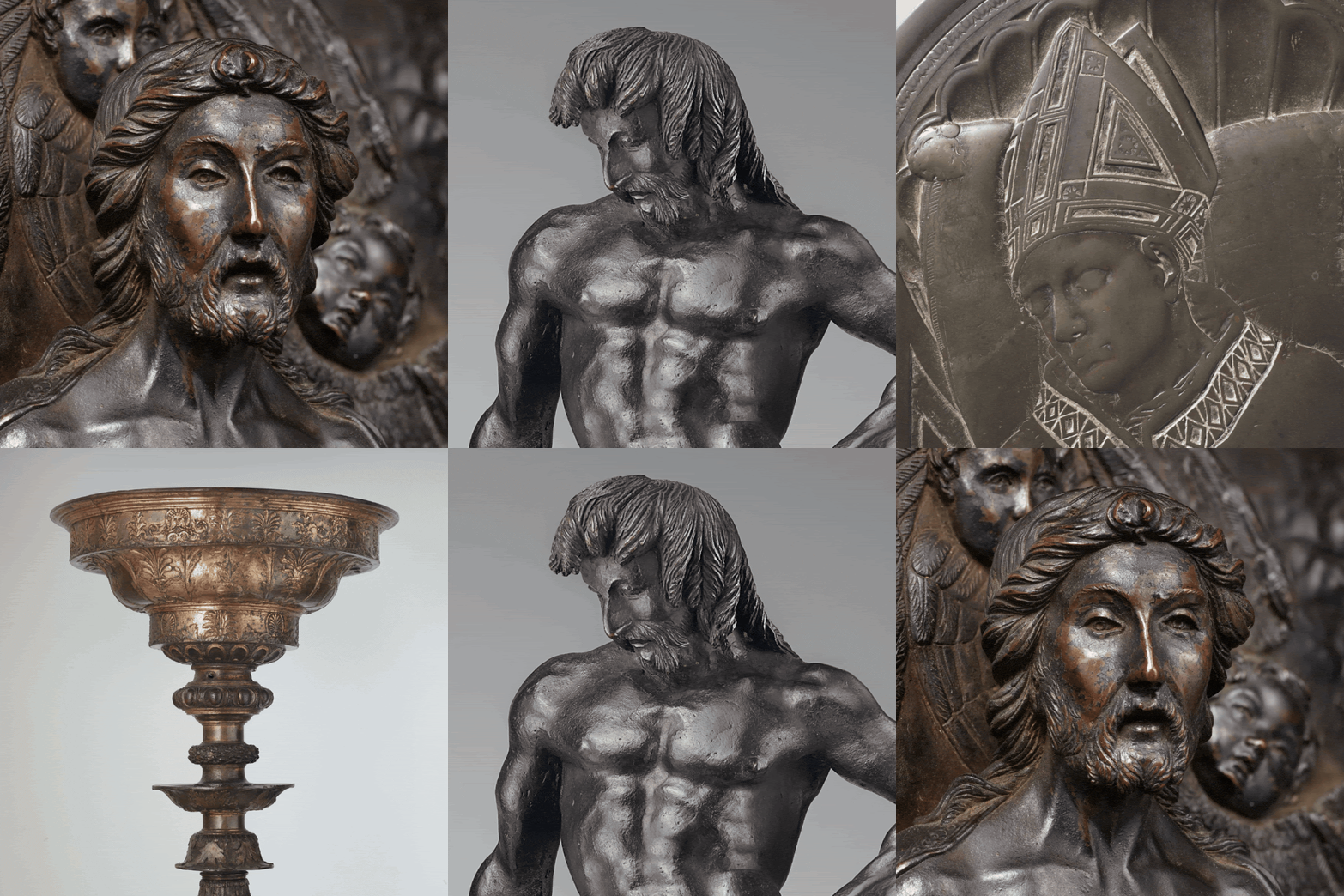
Visitors next enter a small room devoted to Donatello—the most celebrated sculptor of the age—and to his Sienese sojourn of 1457–61. Long presented as yet another episode of Florentine influence on local artists, this moment is radically recast by the exhibition, revealing how Donatello was prevented from producing a single new work in Siena due to political turmoil and local anti-Florentine sentiment. He is therefore represented by the astonishing tomb slab of Giovanni di Bartolomeo Pecci, Bishop of Grosseto—cast before his arrival in the city and sent there for assembly and installation. An over life-size bronze with traces of inlaid enamel or resin, this masterpiece of Renaissance sculpture takes pride of place in the show, exemplifying Donatello’s revolutionary innovations in spatial illusion and expression. One of only eight signed works by the artist in existence, the tomb slab makes its United States debut in this show, having never before been exhibited outside of Tuscany.
The third and largest gallery within the exhibition dives deeper into the possibilities and challenges of expression in bronze. Following the tomb slab by Donatello, the first grouping further explores the memorializing potential of bronze in funerary sculptures. These remarkably present likenesses were usually reserved for higher-ranking members of the clergy, though a notable example in the show is the unfinished monument commemorating Mariano Sozzini the Elder, a jurist of European renown and friend of Pope Pius II. On loan from Florence’s Bargello Museum, it is the only bronze effigy of a layman to survive from fifteenth-century Italy. Sozzini appears newly laid upon a bier, dressed in the robe and headband of his profession, with incredible drapery and lifelike face, feet, and hands that may have been molded directly from the corpse. This section of the show also includes Vecchietta’s last will and testament, which features, in place of a signature, a drawing of his Christ as the Man of Sorrows uniquely created for his own funerary chapel, forever binding the artist’s identity to the last bronze he cast.
The next section features a grouping of significant bronze portrait medals, which— compared to funerary sculptures’ preservation of identity after death—fashioned and promoted sitters’ identities during their lives. The group of eight works are all made by or attributed to Francesco di Giorgio, with portraits of notable rulers, humanists, bankers, and soldiers on the obverse and mythological or allegorical subjects on the reverse. These intimate, handheld, portable objects expanded portraiture beyond mere likeness, revealing another side of the sitter’s identity. Exquisitely crafted, they carried the reputation of both sitter and artist far and wide.
The central section of this gallery reunites for the first time all the portable bronze reliefs produced in Siena in the period—a type of object that flourished there as nowhere else. This genre occupies a fertile space between painting and sculpture, demonstrating sculpture’s ability, in the absence of color, to manipulate light, shadow, space, depth, and narrative drama. Importantly, visitors will be able to see many of the reliefs from both the front and back, revealing the technical challenges inherent to casting these works. Represented here is Francesco di Giorgio, whose boldly untooled surfaces produce atmospheric effects so extraordinary that his reliefs were once attributed to Leonardo da Vinci. By contrast, reliefs by his master, Vecchietta, demonstrate the latter’s more refined and jewel-like clarity. Among these is his masterpiece The Resurrection, the only known signed work by the artist outside of Italy. The relief was a gift from the dealer Joseph Duveen to Henry Clay Frick and served as a major source of inspiration for the exhibition.
The next display is devoted to a group of six freestanding statues and statuettes, a form that tests and exploits the limits of bronze more fully than any other, with dramatically projecting arms, lifted legs, and bodies poised beyond their centers of gravity. Ancient sculpture offered Renaissance artists fruitful examples of such expressive bodies in bronze—but rather than simply reviving antique types, Sienese artists used them as points of departure to test new possibilities of pose, scale, and character.
This display includes a Hercules from Berlin newly attributed to Francesco di Giorgio, shown alongside a closely related statuette from the Frick. Completing the group is a third, monumental Hercules from Dresden, whose iconography, dating, and attribution the exhibition clarifies for the first time. In another pairing, a Frick statuette of David with the Head of Goliath, attributed to Giovanni di maestro Stefano, is shown alongside a smaller work of the same subject attributed to Francesco di Giorgio from the Capodimonte Museum in Naples. Finally, a panel in this section explains the complex, multistep process of bronze casting—notably the lost-wax method, which dates back to antiquity—shedding further light on the enormous efforts that went into producing each work in the show.
Exhibition Catalogue
Siena: The Art of Bronze, 1450–1500 is accompanied by a scholarly catalogue that provides an overview of Siena’s entire bronze production, essays on the different types of works on display, and entries for each object in the show. These texts are complemented by new photography of nearly all of Siena’s surviving fifteenth-century bronzes, newly discovered archival documents, and extensive scientific analysis coordinated by Victoria Schussler, Associate Conservator at the Frick.
The catalogue is authored by Dalvit with extensive contributions by an international group of esteemed scholars: Machtelt Brüggen Israëls (University of Amsterdam and the Rijksmuseum), Giampaolo Ermini (independent scholar), Gabriele Fattorini (University of Florence), Laura Goldenbaum (Humboldt Forum, Berlin), Scott Nethersole (Radboud University, Nijmegen), Alison Wright (University College London), and Giulia Zaccariotto (Accademia Carrara, Bergamo).
The hardcover volume of nearly 400 pages is published by The Frick Collection in association with Paul Holberton Publishing ($60; Frick members: $48 in-store, $54 online). The book will be available for purchase in the Museum Shop, online at shop.frick.org, or by contacting shop@frick.org or 212.547.6849.
The publication is made possible by Clémence and William von Mueffling and the Robert Lehman Foundation.
Exhibition Support
Leadership support is provided by an anonymous donor in honor of Ian Wardropper and by Margot and Jeremiah M. Bogert, Elizabeth M. and Jean-Marie R. Eveillard, and The Christian Humann Foundation.
Major support is provided by Clémence and William von Mueffling, Fondazione Bracco, the Robert Lehman Foundation, the David L. Klein, Jr. Foundation, The Eric & Jane Nord Family Fund for Exhibition Programming, and The Gladys Krieble Delmas Foundation.
Additional support is provided by Filippo Benappi; Andrew Butterfield and Claire Schiffman; The Helen Clay Frick Foundation; Mr. and Mrs. Hubert L. Goldschmidt; Jon and Barbara Landau; Wendy Lewison; Carlo Orsi, Trinity Fine Art; Jane Richards; Sabina and Harlan Stone; the Malcolm Hewitt Wiener Foundation; Bosilika An in honor of the Abbruzzese Family; Eric Blair-Joannou; Loren Davis; Bailey Foote; and Alexander Mason Hankin.
_______________________________________________________
 Housed in one of New York City’s last great Gilded Age homes, The Frick Collection provides intimate encounters with one of the world’s foremost collections of fine and decorative arts. Open since 1935, the institution originated with Henry Clay Frick, who bequeathed his Fifth Avenue residence and collection of European paintings, sculpture, and decorative arts for the enjoyment of the public. The museum’s holdings, which encompass masterworks from the Renaissance to the late nineteenth century, have grown over the decades, more than doubling in number since the opening of the museum. The Frick Art Research Library, founded more than one hundred years ago by Henry Clay Frick’s daughter, Helen Clay Frick, is a leading art history research center that serves students, scholars, and the public.
For more information, please visit frick.org.
Basic Information
Website: frick.org
Email: communications@frick.org
Visit: frick.org/visit
Tickets: frick.org/tickets
Mobile Guide: frick.org/app
Programs: frick.org/programs
Explore: frick.org/explore
Library: frick.org/visit/library
Shop: shop.frick.org
————————————————–
PLAN YOUR VISIT
Timed tickets are recommended.
Members visit free, with no reservations!
Your generosity sustains our world-class public programs, research, and conservation efforts.
Museum and library news straight to your inbox.
Sign up today!