

Major Exhibition Traces Ragtime’s Journey from Black American Roots to the Mainstream
Ragtime: Cakewalk in Pianoland
On view November 13, 2026, through June 13, 2027
The Morgan Library & Museum presents
Ragtime: Cakewalk in Pianoland
an exhibition introducing visitors to one of
the first truly global popular-music styles. On view
from November 13, 2026, through June 13, 2027, the
exhibition follows ragtime’s path, from the musical
traditions of enslaved Black people to the parlors and
saloons of rising industrial centers in nineteenth-
century America, and on to the nightclubs and concert halls of the world. Along the way, the exhibition tells a story fundamental to American culture, one that connects ragtime to jazz, rock, and hip-hop: how Black cultural traditions and creativity have continually shaped, influenced, and been adapted within American music and art. Featuring selections from The John Davis Collection of Early Printed Musical African Americana as its foundation, the exhibition also includes works from the Morgan’s holdings as well as from a number of private collections.
———————-
Above — Scott Joplin (1868-1917) Maple Leaf Rag St. Louis: John Stark & Son, 1899, front cover.
The Morgan Library & Museum, Mary Flagler Cary Collection, PMC 2830.——————————–
“Ragtime transformed American music, laying important groundwork for jazz
and influencing generations of musicians,” said Colin B. Bailey, Katharine J. Rayner Director.
——————————–
“The Morgan is an ideal place to tell this story through the printed music and other materials in our collection that document ragtime’s history and cultural impact, including our significant holdings of works by Scott Joplin. We are especially grateful to John Davis for his participation and generosity, and for lending us significant items from his extraordinary collection. This has enabled us to bring together works from the Morgan with materials from other collections to offer a fuller picture of ragtime and its enduring legacy.”
 Though ragtime’s origins are often traced to Midwestern saloons in the late nineteenth century, its roots lie in African American musical traditions shaped over generations by the blending of African, European, and other influences. Rather than tracing the history of ragtime to 1895, when the earliest sheet music in this genre became available on the market, the exhibition begins in the late eighteenth century with Black caricature on the stage.
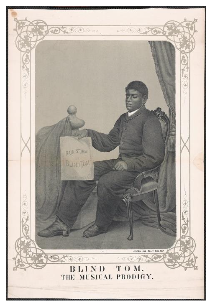
The opening section, “Diamond in the Rough,” examines blackface and racial mimicry, including Charles Dibdin’s 1768 opera The Padlock, one of the earliest instances of European actors “performing” Black culture, and the story of “Blind Tom” Wiggins, an enslaved prodigy whose musicianship was tarnished by exploitation from both his handlers and the public.
The section that follows, “Risky Business,” confronts the rise of blackface minstrelsy, a tradition that many in the Black community regarded with revulsion even as it became a source of livelihood for Black performers, including artists such as the Fisk Jubilee Singers, the Hyers Sisters, Sam Lucas, and James A. Bland. Though the form was meant to denigrate these very performers, classically trained artists across generations were in some cases able to subvert its conventions from within.
——————————–
“Blind Tom, the Musical Prodigy.” Lithograph Philadelphia: Ledger Job Printing, [ca. 1865] The John Davis Collection of Musical African Americana, L2026.86.37. Photo © Thomas Palmer.
——————————–
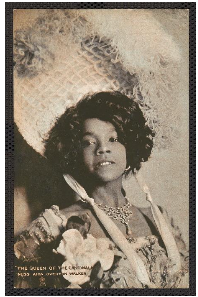
“Rags for Bags” centers on the career of Ernest Hogan (1865–1909), one of the songwriters often identified among the originators of ragtime. Born Reuben Crowdus in Bowling Green, Kentucky, he started his career in minstrel troupes and became a comedian in the period of the racist “coon songs” from which he profited. Like many other Black performers, he struggled against negative racial
stereotypes while reinforcing them in his work. The section also tells the story of Hogan’s collaborators: the opera singer Sissieretta Jones and the vaudeville performer and dancer Aida Overton Walker, known as the Queen of the Cakewalk, each of whom pushed against the limits placed on Black women performers.
The next section, “Long Live the King,” focuses on the composer Scott Joplin (1868–1917), whose piano ragtime defined the era and most epitomizes ragtime in the public imagination today. Through his partnership with publisher John Stark, Joplin sought to bring ragtime into the classical music domain. A highlight of the section is the original agreement signed between Joplin and Stark for Joplin’s “Maple Leaf Rag,” showing that Joplin, unusually, received a royalty for his work. Published in 1899, the piece was one of the best-selling and most defining titles of the era. With the rise of sheet music distribution and the player piano, a mechanical instrument that plays automatically, ragtime found its way into homes across the country, preserving the Black oral traditions from which the music came, while also adapting its sound for white and mainstream audiences.
“Homegrown” focuses on ragtime as a product of Black innovation and Black American experiences, which coincided directly with the federal legitimation of Jim Crow laws under Plessy v. Ferguson in 1896. The section traces ragtime’s move into Broadway musical theater through works by Will Marion Cook, Bert Williams, and George Walker, as well as the literary responses of writers including Charles W. Chesnutt, Paul Laurence Dunbar, and
——————————–
“The Queen of the Cakewalk, Aida Overton Walker” Postcard. England: Raphael Tuck & Sons, n.d. Photomechanical Print.
The John Davis Collection of Musical African Americana, L2026.86.41.
——————————–
 The penultimate section, “Rock the Boater,” explores ragtime’s widespread adoption in American popular culture during the early 20th century. Its extraordinary popularity gave rise to what is often referred to as the “ragtime era,” which reached its height in the first two decades of the century. Ragtime’s syncopated rhythms were adopted into fashionable dance and dress, becoming increasingly mainstream and reaching predominantly white audiences. Ragtime found a home at the Clef Club in New York, and its acceptance into the mainstream sometimes created opportunities for racially integrated performances, including at Carnegie Hall, though it never fully escaped the racial stereotypes and representations that underlay its appeal. This section also examines the ragtime revival of the 1950s, which brought renewed attention to artists such as Eubie Blake.
The exhibition concludes with “Crossing Over,” which traces ragtime’s afterlife, from its engagement by European modernists such as Igor Stravinsky, to its role in E. L. Doctorow’s 1975 novel Ragtime and its film and stage adaptations, to its later twentieth-century revival, spurred by the rediscovery of Joplin’s scores. The section also considers ragtime’s later use in familiar forms of entertainment, including children’s cartoons, ice cream trucks, and video games, further embedding the genre in the American consciousness. The section closes by placing that history in dialogue with works by contemporary Black artists Ellen Banks, Yusuf Hassan, Henry Fort II, and Aminah Brenda Lynn Robinson, each of whom reclaims ragtime’s legacy on their own terms.
——————————–
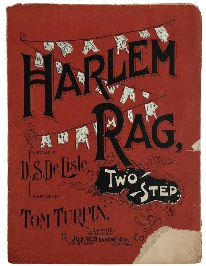
Thomas Turpin (1871[?]–1922), Harlem Rag: Two Step, Arranged by William H. Tyers (1870–1924), New York: Jos. W. Stern, 1899. Martin Eggers & Virginia Tichenor. Trebor Jay Tichenor Collection
——————————–
Organization
Ragtime: Cakewalk in Pianoland is organized by Jesse Erickson, Astor Curator and Department Head, Printed Books and Bindings; Robinson McClellan, Mary Flagler Cary Curator, Music Manuscripts and Printed Music; and John Davis, Guest Curator.
Sponsorship
Ragtime: Cakewalk in Pianoland is made possible by Katharine J. Rayner and Denise Littlefield Sobel, with generous support from Brook Berlind, Mark Jenkins and Karen Holland, and Mr. G. Scott Clemons and Ms. Karyn Joaquino. Additional support was provided by Henrietta Paige Hakes and the Charles E. Pierce Jr. Fund for Exhibitions.
Publication
A catalogue featuring essays by the curators accompanies the exhibition. Jesse Erickson illustrates how ragtime, with the banjo as its driving instrumental force, emerged from the lively tradition of Black American and blackface minstrel performance that made its way from vaudeville to Broadway. Robinson McClellan takes a closer look at the piano side of ragtime’s cultural identity, examining how a vernacular tradition rooted in improvisation and folk musicianship was translated through the technology of written music notation into the literary art of composition and commercial publishing. John Davis roots the exhibition in his remarkable collection, exploring both the personal and historical importance of its objects. The book will be available at the Morgan Shop for $30.
Programs
Related programs include a curator roundtable on Friday, November 13, 2026; a concert featuring John Davis on Wednesday, November 18, 2026 (sold out); a screening of the film Ragtime (1981) on Saturday, February 13, 2027; a gallery talk with artist Yusuf Hassan on Friday, February 19, 2027; a concert featuring Poulenc Trio on Wednesday, February 24, 2027; a screening of the film The Sting (1973) on Saturday, May 15, 2027; a gallery talk with Rick Benjamin, the founder and conductor of the Paragon Ragtime Orchestra, and a concert featuring Paragon Ragtime Orchestra, both on Wednesday, May 19, 2027.
Audio Guide
Accompanying the exhibition is an audio tour featuring curators Jesse Erickson, Robinson McClellan, and John Davis, available within the Morgan’s digital guide on Bloomberg Connects, the free arts and culture app.
~~~~~~~~~~~~~~~~~~~~~~~~~~~~~~~~~~~~
The Morgan Library & Museum is a museum and independent research library in the heart of New York City. Originally the personal library of financier J. Pierpont Morgan, the Morgan’s collections span 4000 BCE to the present and are explored through exhibitions, scholarship, and public programs. Guided by the conviction that meaningful engagement with art, literature, music, and history enriches lives and deepens understanding, the Morgan inspires curiosity, learning, and discovery for audiences of all ages.
For more information, the public can call 212-685-0008 or visit themorgan.org.
———————————–
Visit AAQ / Museum Architecture: The Morgan Library & Museum, NYC / 2006 … Link
================================================


AAQ / Resource
Stelle Lomont Rouhani Architects
===================================

AAQ / Resource: Ben Krupinski Builder
========================================

AAQ / Resource: Riverhead Bay Motors
________________________________________________