~~~~~~~~~
THE MANHANSETS
SHELTER ISLAND’S ORIGINAL INHABITANTS
———————
|
America is celebrating its 250th anniversary this year. But long before our Revolutionary ancestors set foot on Shelter Island — some 4000 years ago, in fact — the Manhanset Indians had settled here. One of Long Island’s 13 tribes, this branch of the Algonquins occupied about 25 sites on Shelter Island, which they called “Manhansack-aqua-quash-awamock,” or an “island sheltered by islands.”
|
|
|
According to Muriel Porter Weaver’s Where They Go By Water, “In spring, summer and fall, small family groups of Manhansets established residential hunting and fishing camps…They clammed and fished the bays, creeks and salt marshes. On wooded uplands men hunter deer, bear, wolves and raccoons. Women gathered, dried and preserved acorns, hickory nuts, wild cherries, sumac, elderberries and mustard. They fashioned moccasins, breech clothes, and skirts from deer, rabbit and bear skins.”
|
|
|
|
To accomplish this, they used a variety of tools, which are described in the SIHM exhibit, “Our First Inhabitants – the Manhansets.” We’ve highlighted two types of tools — Atlatl Weights and Antler Flakes. Some of the tools were excavated by Roy Latham, who detailed his findings in a report on Shelter Island’s Native Americans. On one site close to the Mashomack Preserve — the Smith site — Latham found “artifacts such as axes, celts, pestles, mortars, projectile points, and pottery,” as well as the “presence of hearths, [and] two house structures,”…“indications of an established settlement,” according to Porter Weaver.
|
|
|
The head of the Manhansets was its Sachem. In his 1932 The History of Shelter Island, author Ralph Duvall noted that, when Europeans first came to our Island, the Sachem at the time was Pogatticut. “Pogatticut was not only the Sachem of the Manhanset tribe, but was the Grand Sachem of most if not all of the tribes of Long Island,” wrote Duvall. Today’s Shelter Island travelers can actually visit a site frequented by Pogatticut — Sunset Rock. The SI Chamber of Commerce’s 2022 guide to the little-known historic places of Shelter Island described Sunset Rock as the “throne of Sachem Pogatticut, king of the Manhanset native peoples.”
|
|
|
Pogatticut was getting on in years by the time the first Europeans arrived on Shelter Island. That was in 1637, when James Farratt, an agent for the Scottish Earl of Stirling, was sent to colonize Long Island. For his efforts, he was compensated with Robins Island and our own “rock.” Farratt claimed to have bought rights to Shelter Island from the Manhansets, but there were some doubts about that “bargain.” Nonetheless, he sold his interest to four sugar merchants, among them, Nathaniel Sylvester. Finally, in 1653, Porter Weaver writes, “the aging Pogatticut deeded away Shelter Island, delivering the traditional ‘turf and twig’…to Sylvester…and ‘did freely and willingly depart the aforesaid island.’…[S]hortly thereafter, Pogatticut died. Befitting his sachem status, he was carried to Montauk for burial in the traditional upright seated position.”
For more information on the Manhansets, visit the SIHM exhibit. And while here, check out the Havens Store for Where They Go By Water and other books on Shelter Island’s rich history.
~~~~~~~~~~~~~~~~~~~
|
|
|
Shelter Island History Museum
16 South Ferry Road
Shelter Island, NY 11964
631-749-0025
Open Wednesday – Friday
10am to 2pm
——————————
|
|
|
Shelter Island History Museum
16 South Ferry Road, PO BOX 847
Shelter Island, NY 11964
|
|
|
|
——————————
==============================================
Old Fashioned Hospitality
===============================================

Visit website
AAQ / Resource
=============================================

__________________________________________________________



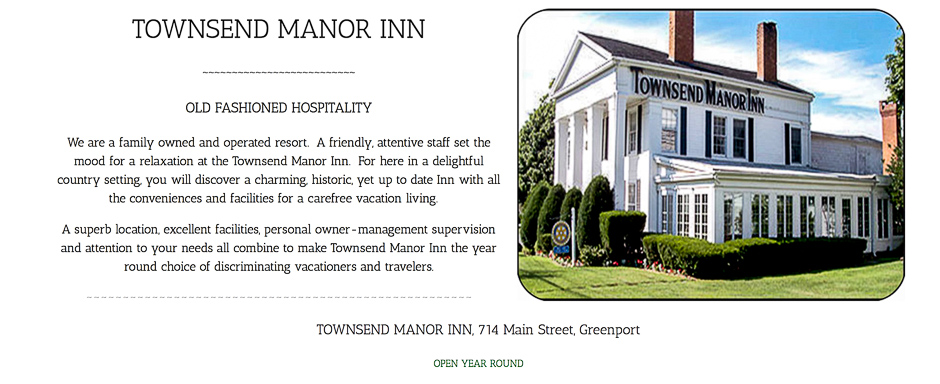 AAQ / Resource: Townsend Manor Inn