
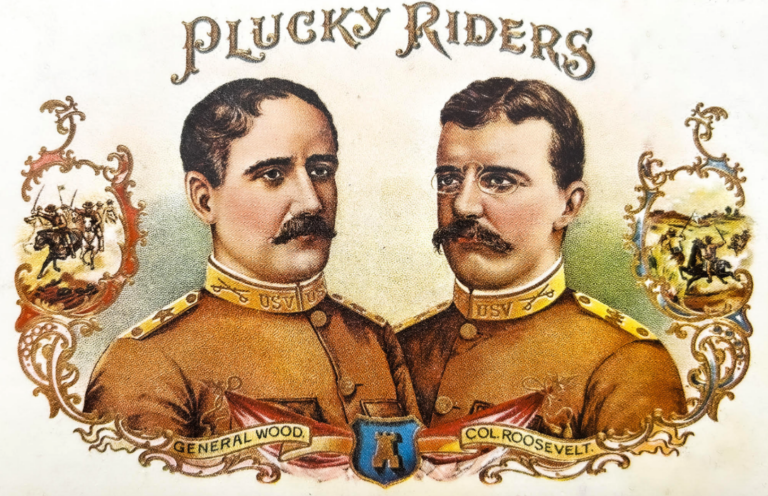
Courtesy of the Theodore Roosevelt Collection, Harvard University.
Both Wood and Roosevelt were Medal of Honor winners. Leonard Wood, graduate of Harvard Medical School,
for service in Apache Wars and Theodore Roosevelt, graduate of Harvard University,
awarded 2001, for gallantry at San Juan Hill, July 1st, 1898.
~~~~~~~~~~~~~~~~~~~~~~~~~~~~~~~~~~~
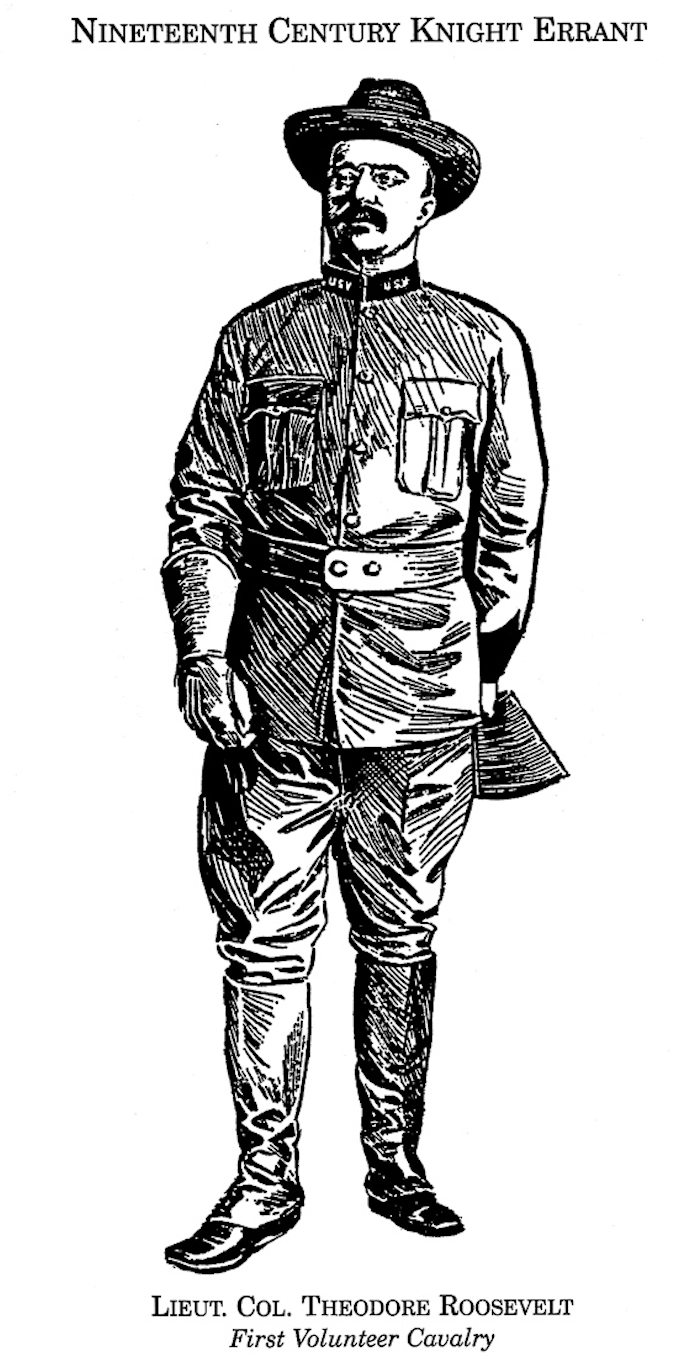
The ideal of le beau sabreur — dashing, fearless, full of vim.
— Boston Globe, June 6, 1898
———————————


Commemorative Medal designed by Lieut. Frederick Wingte of Company I, an artist of merit. The bar pin bears the engraving “1st U.S. Vol. Cav.” and is supported by a pair of eagle’s wings, with a horseshoe at the point joining the emblem of the Cavalry Division. The medal bears a cross-section of a bastion, which is the insignium of the Fifth Army Corps, and the names of the battles in which the regiment distinguished itself: San Juan, Las Guasimas and Santiago.
— NY Sun, page 338 (rendered here by Illustrator George Bloem, 1997)
Page numbers reference BULLY!
~~~~~~~~~~~~~~~~~~~~~~~~~~~~~~~~

Colors & Color Sergeant Wright of the Rough Riders carried their flag during the battles.
New York Herald / Illustrator, James Gordon Bennett / New York Herald, page 60.
~~~~~~~~~~~~~~~~~~~~~~~~~~~~~~~~
“Nobody need make any mistake about that being a good regiment. The Western men were as good as soldiers before they enlisted
…The Eastern men were fellows whose nerve and pride carried them along neck-and-neck with the cowboys.
Yes, that’s a splendid regiment.“
General William Shafter
— The Sun, September 3, 1898.
~~~~~~~~~~~~~~~~~~~~~~~~~~~~~~~~
ROOSEVELT and WHEELER ASHORE
As the Transport Miami docked at the Iron Pier, two figures were distinguished among the officers on the bridge and there went up a roar, “Hurrah for Roosevelt! Hurrah for Wheeler!”…so, the two heroes stood, bowing and smiling until the ship’s side touched the dock. Then, an officer on the pier shouted, “How are you Colonel Roosevelt?”
Back came the answer in a voice that could be heard half a mile away, “I am feeling disgracefully well,” then after a pause, “I am positively ashamed of my appearance when I see how badly off some of my brave fellows are.” Then, after a brief pause, in tones of intense conviction, “Oh, but we have had a bully fight!” ….
— New York Herald, page 62.
~~~~~~~~~~~~~~~~~~~~~~~~~~~~~~~~

Colonel Roosevelt and Rough Rider Woodbury Kane, a Knickerbocker.
— New York Press / Illustrator, W.H. Shindler, page 65.
~~~~~~~~~~~~~~~~~~~~~~~~~~~~~~~~
Song of the Rough Riders
Rough Riders were we from the West,
Gallant gentlemen the rest,
Of volunteers the best,
Rallied to the flag at Roosevelt’s behest
To carve our way to glory…..”
Composed by Private Edwin Emerson, Jr., Troop K, Rough Riders, graduate of Harvard.
— New York Times, pages 73 – 74.
~~~~~~~~~~~~~~~~~~~~~~~~~~~~~~~~
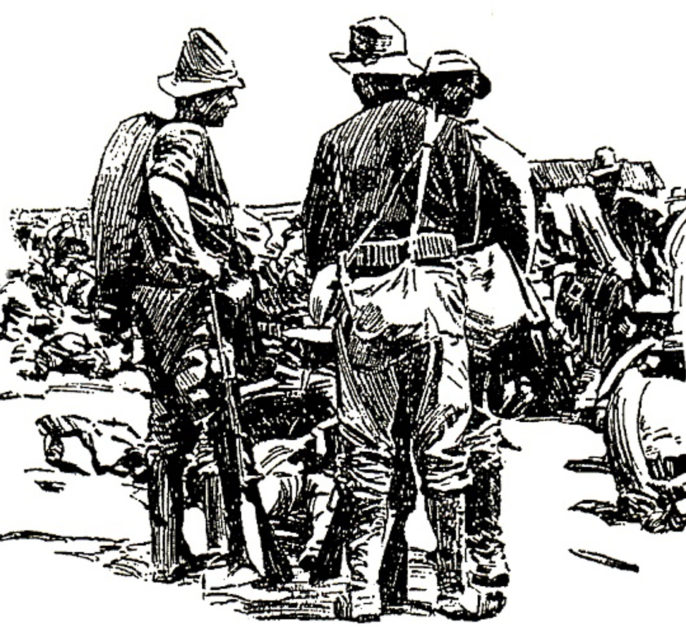
Rough Riders Wrenn, Larned, and Bull. Charlie Bull was a Harvard oarsman;
Bob Wrenn and William Larned, tennis players. — New York Herald, page 67.
~~~~~~~~~~~~~~~~~~~~~~~~~~~~~~~~
The Rough Riders
Editorial — The Rough Riders are, of all regiments, the public’s favorite. They form the one regiment that belongs to no state. They represent the whole country, and Texas feels as much local pride in them as does New York. They represent no one walk in life and no one grade in society….The regiment was in a very deep sense a Roosevelt regiment. A more ideal commander for such an organization could not be found than the gallant, dashing and impetuous Roosevelt.
—- Commercial Advertiser, pages 75 – 76.
~~~~~~~~~~~~~~~~~~~~~~~~~~~~~~~~.
Dashing Bravery of the Rough Riders
…. This regiment when it was first organized was criticized and ridiculed. It was compared to regiments of Bowery Boys and volunteer firemen who ran away at Bull Run. But the difference lay in the fact that the personnel in this regiment is somewhat higher than that of men who rob drunken sailors and deliver knock out drops to countrymen who go sightseeing on the Bowery…..
— Richard Harding Davis, war correspondent at San Juan Hill, July 1st, 1898.
— New York Herald, pages 520 – 521.
~~~~~~~~~~~~~~~~~~~~~~~~~~~~~~~~
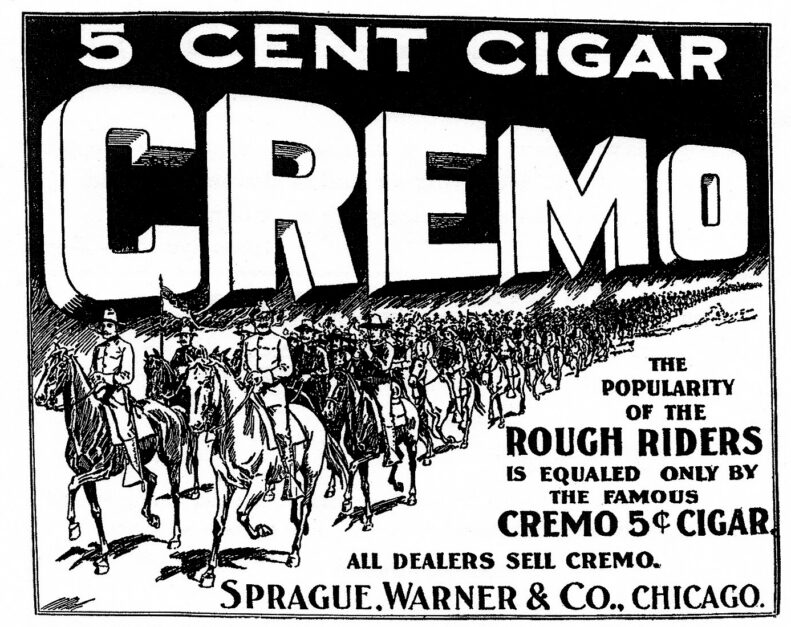
— Chicago Tribune, page 86
~~~~~~~~~~~~~~~~~~~~~~~~~~~~~~~~

All returning soldiers were required to spend four days at the Detention Hospital’s 4-acre site. Severely ill soldiers remained,
less ill were sent to the General Hospital, and healthy soldiers went to their regimental camp sites.
— Illustrator: Chambers / The World, page 88.
~~~~~~~~~~~~~~~~~~~~~~~~~~~~~~~~
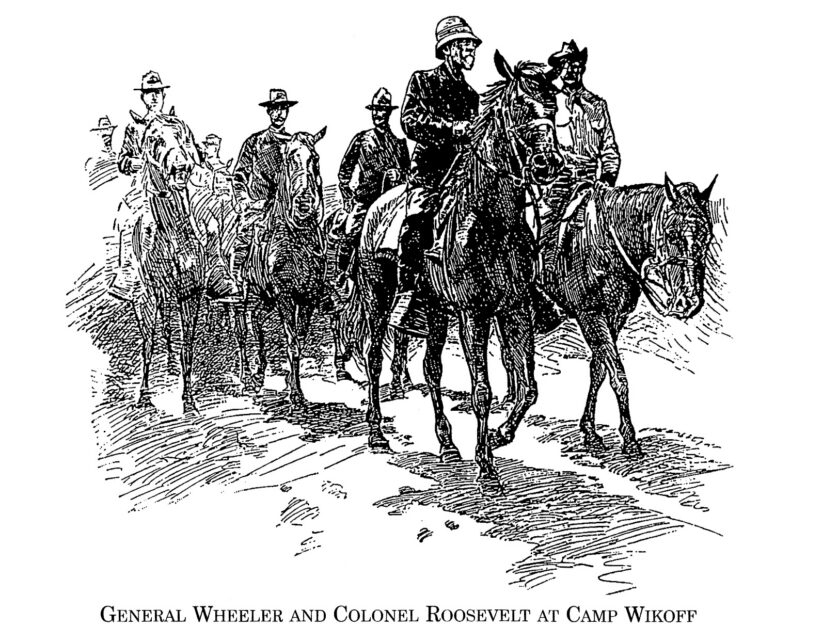
“Those Rough Riders would do anything you asked from storming San Juan Hill to washing the ship.”
— General Joseph Wheeler. — The World, pages 79 – 81 | Illustration, New York Herald.
~~~~~~~~~~~~~~~~~~~~~~~~~~~~~~~~
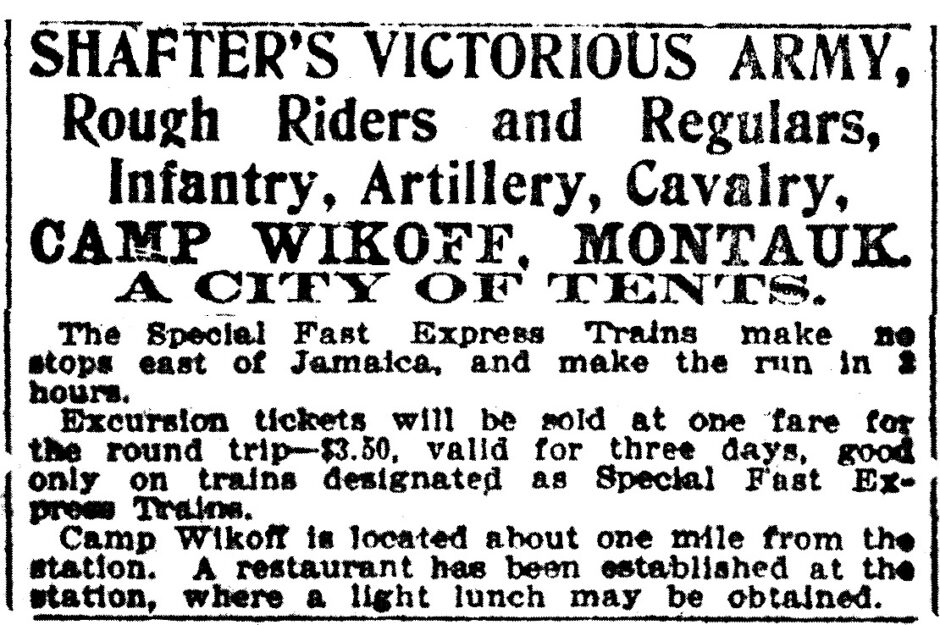
— Brooklyn Daily Eagle, page 227.
~~~~~~~~~~~~~~~~~~~~~~~~~~~~~~~~
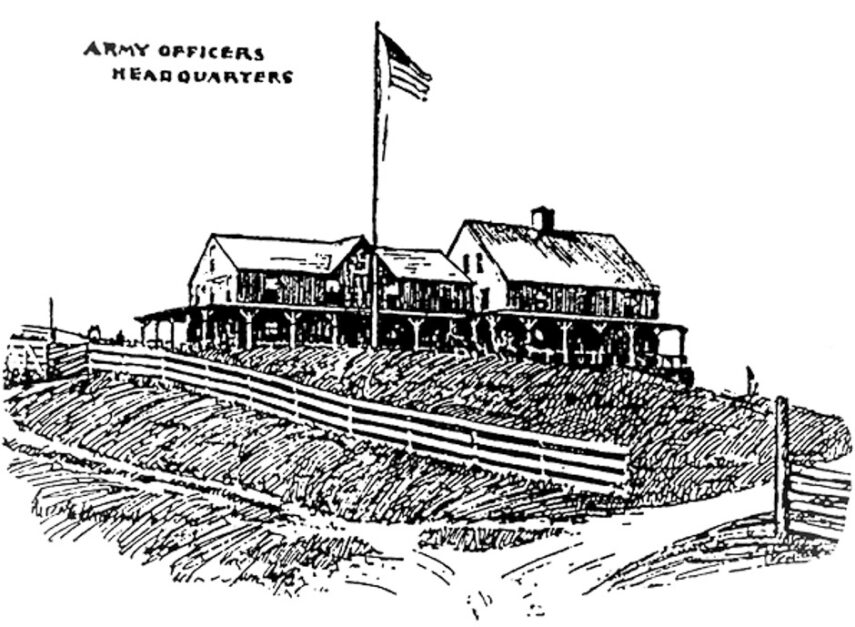
Third House, 1804, Montauk — an inn for officers at Camp Wikoff. Col. Roosevelt stayed there with his wife, Edith, on August 18th & 19th before leaving Camp Wikoff on a four-day furlough to Sagamore Hill, Oyster Bay. — Report, NYT / Illustration, New York Herald.
Note that Third House is next door to Deep Hollow Ranch, 1658, the oldest continuously operating ranch in the United States.
Birthplace of the American Cowboy.
— Illustration, New York Herald, page 91.
~~~~~~~~~~~~~~~~~~~~~~~~~~~~~~~~
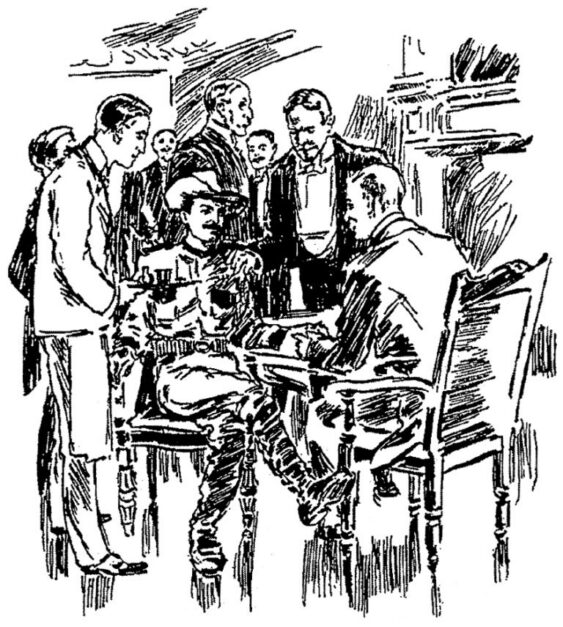
Rough Rider Craig Wadsworth surrounded by friends at the Knickerbocker Club, NYC.
— New York Herald, page 103.
~~~~~~~~~~~~~~~~~~~~~~~~~~~~~~~~
Lieut. William Tiffany, grandnephew of Commodore Perry, and member of the Knickerbocker Quartet,
died of starvation shortly after his return to Boston, following a six-hour delay waiting for provisions in Fort Pond Bay.
‘Army Beef Scandal’ of 1898, pp. 526 – 529.
— Illustration, The World, page 129.
~~~~~~~~~~~~~~~~~~~~~~~~~~~~~~~~

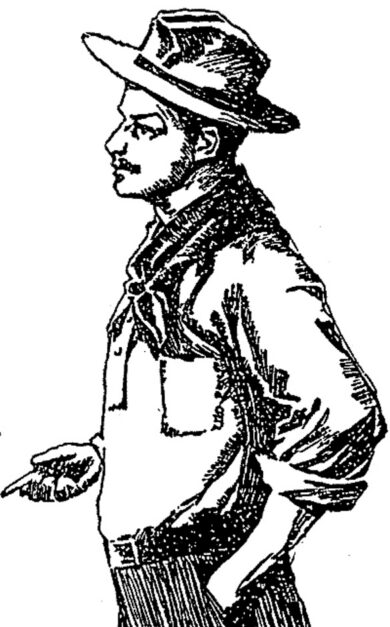
COLONEL THEODORE ROOSEVELT
“An that’s the feller we Western cowpunchers was sort o’dubious about,” chuckled the Arizona Rough Rider. “I’d like to find the man now that would call him a college-bred dude.”
— “All Proud of Roosevelt,” The Sun, pages 147 – 151 / Illustration, New York Press, page 149.
—– New York Press, page 149.
~~~~~~~~~~~~~~~~~~~~~~~~~~~~~~~~
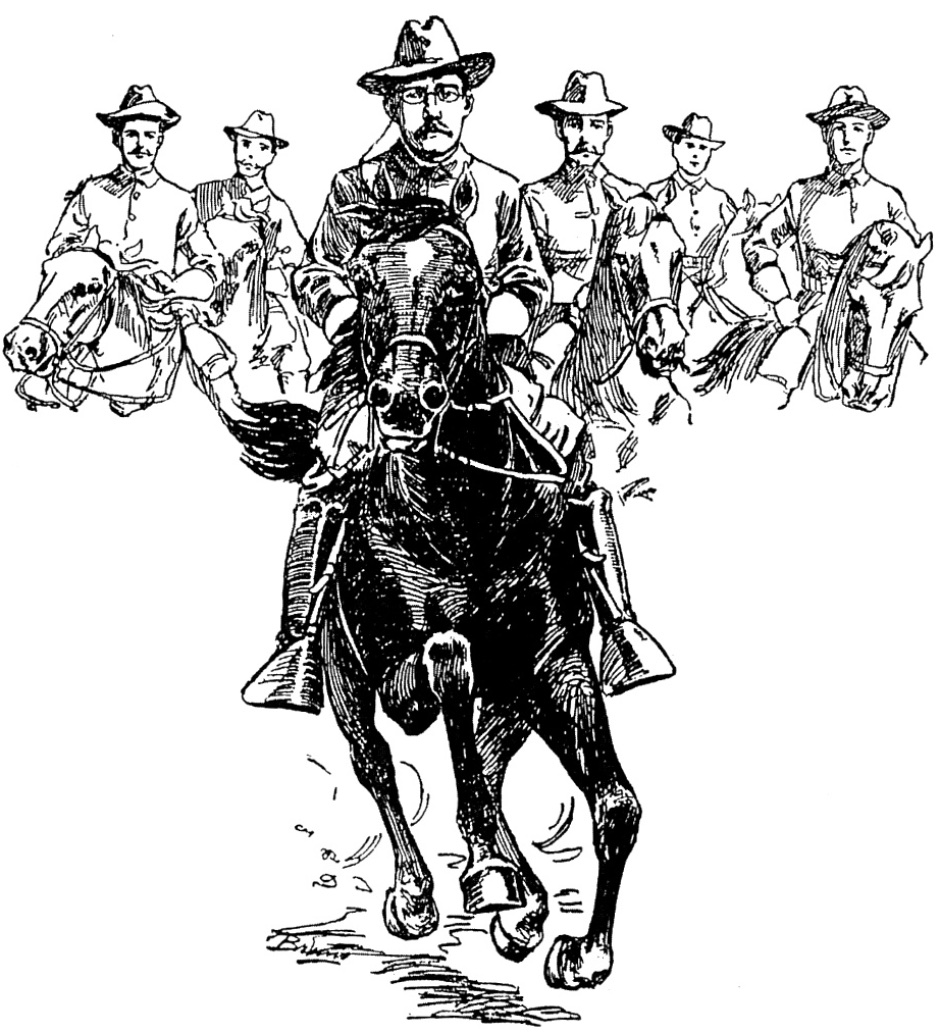
Roosevelt Leading His Troops
“… but those Rough Riders — look at that now.
See how their arms are fixed — just right; and their seat comfortable,
deep down in the saddle, and their hats — look at the hats!
Oh, say, they’re the stuff, they are; the real, genuine stuff.”
— J.L. S., Commercial Advertiser, page 142 / Illustration, The World, page 152.
———————————
In the afternoons, Roosevelt would lead a squad of his Rough Riders to the beach at Ditch Plains for a plunge in the ocean.
“Phew! that makes a man feel alive,” he said trotting out of the water…a few minutes later he was again leading his squad in a race across the landscape.
–– “Rough Riders at Play” / The Sun, page 163.
~~~~~~~~~~~~~~~~~~~~~~~~~~~~~~~~

His feats in markmanship are the talk of the regiment.
Rough Rider Cherokee Bill — The World, page 161.
~~~~~~~~~~~~~~~~~~~~~~~~~~~~~~~~
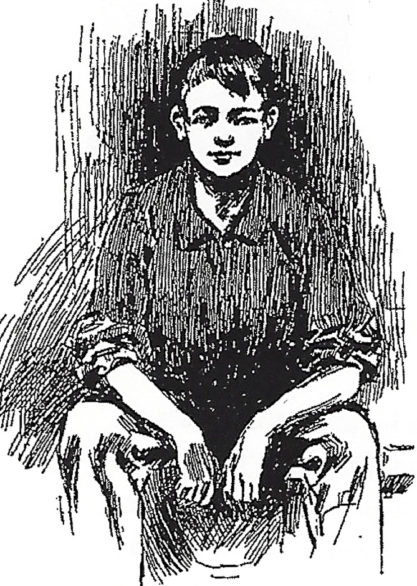
Rough Rider Mascot, Dabney S. Royster, age 13, from Memphis, Tennessee.
“I want to join the army and be a soldier, not for a little while, but all the time.”
— The World, page 162.
~~~~~~~~~~~~~~~~~~~~~~~~~~~~~~~~

Rough Rider James B. Douglas, oldest soldier in the Regiment,
spent three years in the Sixth Cavalry during the Civil War.
–– New York Press, page 179.
~~~~~~~~~~~~~~~~~~~~~~~~~~~~~~~~

Colonel Roosevelt Cheers Bronco Busting.
— The World, pages 215 – 217.
~~~~~~~~~~~~~~~~~~~~~~~~~~~~~~~~


Commander-in-Chief of the Joint Forces.
————
Just after arriving at Montauk Station in the Presidential Pullman Car, President William McKinley spotted Col. Roosevelt on horseback. Nothing more cordial than the meeting between the President and Col. Roosevelt could be imagined. The President just grinned all over.
“Colonel Roosevelt,” said President McKinley, “I am glad to see you looking so well.”
“Thank you, Mr. President. There is not a healthier man in camp … I want you to see my boys while you are here.”
“Oh, I will, Colonel. I will.” President McKinley replied.
————
President McKinley toured the camp for five hours, visiting both the Detention and General Hospitals, stopping to speak to many of the debilitated soldiers. Surveying Camp Wikoff from a hilltop, he remarked,
“This is beautiful. I think I have never seen a handsomer camp.”

President McKinley addressed the cheering soldiers of the Fifth Army Corps
on the Great Plain in Montauk, telling them,
“I am glad to meet you. I bring you the gratitude of the nation
to whose history you have added a new and glorious page.
“You have come home after two months of severe campaigning,
which has embraced assault, siege and battle — so brilliant in achievement,
so far-reaching in results as to earn the unstinted praise of all your countrymen.”
— Pages 230 – 248, New York Tribune, The Sun, New York Times, New York Press
~~~~~~~~~~~~~~~~~~~~~~~~~~~~~~~~
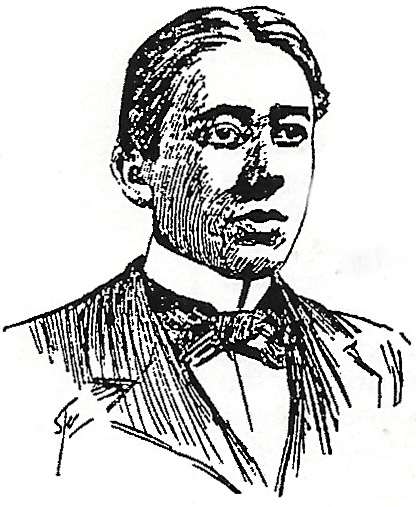
Rough Rider Dilwyn Bell
“My son! My son!” his mother cried out when she found him lying on the ground at Camp Wikoff.
— Chicago Tribune, page 250.
~~~~~~~~~~~~~~~~~~~~~~~~~~~~~~~~

Camp scene Monday morning of Camp Wikoff. Alongside the winding road in the center of the picture
is the headquarters of Col. Roosevelt’s Rough Riders.
— New York Herald / Illustrator, W.H. Shindler, page 260.
~~~~~~~~~~~~~~~~~~~~~~~~~~~~~~~~


Montauk Point Lighthouse, 1795, Commissioned by President George Washington.
Montauk Light was a symbol of hope for the war-weary soldiers returning home
on over-crowded transports from Cuba.
— Illustration, The World, page 287.
————————–

On September 6th, Colonel Roosevelt, with several Rough Riders, visited the Lighthouse,
signing the visitor log.
Thousands of soldiers visited the lighthouse during their stay at Camp Wikoff.
Col. Roosevelt’s signature courtesy of the Montauk Historical Society.
~~~~~~~~~~~~~~~~~~~~~~~~~~~~~~~~
Colonel Roosevelt stood at the entrance to the mess tent, with his head up, his chest expanded, and his powerful arms outstretched, breathing deep of the fresh sea air.
“Oh,” he said with a long sigh of prophetic regret, “I’ll miss this place when it’s all over!”
— “Rooseveltian Appetite,” The Sun, pages 318 – 319.
~~~~~~~~~~~~~~~~~~~~~~~~~~~~~~~~
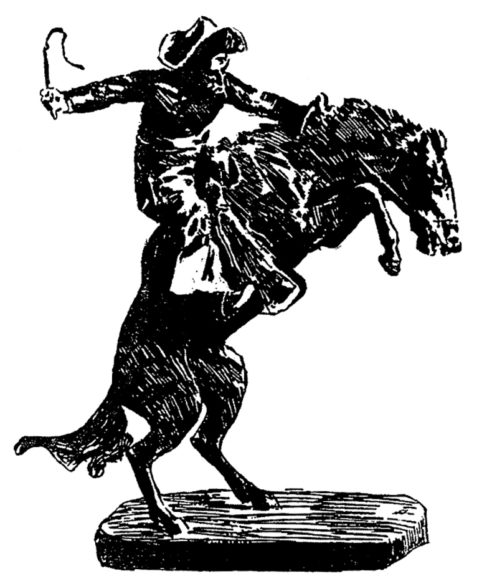
Bronco Buster
Frederic Remington Bronze given to Col. Roosevelt in appreciation of his leadership.
In bidding farewell to the Rough Riders, Roosevelt says,
“You cannot imagine how proud I am of your friendship and regard.”
— New York Tribune, pages 323 – 328 / Illustration, The World.
~~~~~~~~~~~~~~~~~~~~~~~~~~~~~~~~

SAGAMORE HILL, Oyster Bay
Col. Roosevelt left Camp Wikoff at 9 AM, September 15th, by train bound for Sagamore Hill,
accompanied by Lieuts. Greenway, McIlhenny, Ballard, and Sayre.
“Every room, from reception to gun room, is filled with books….Theodore Roosevelt, Jr., age 11, thinks
‘Ranch Life and The Hunting Trail’, published in 1888, is the finest book ever written.”
—— Brooklyn Daily Eagle, pages 331 – 334.
~~~~~~~~~~~~~~~~~~~~~~~~~~~~~~~~
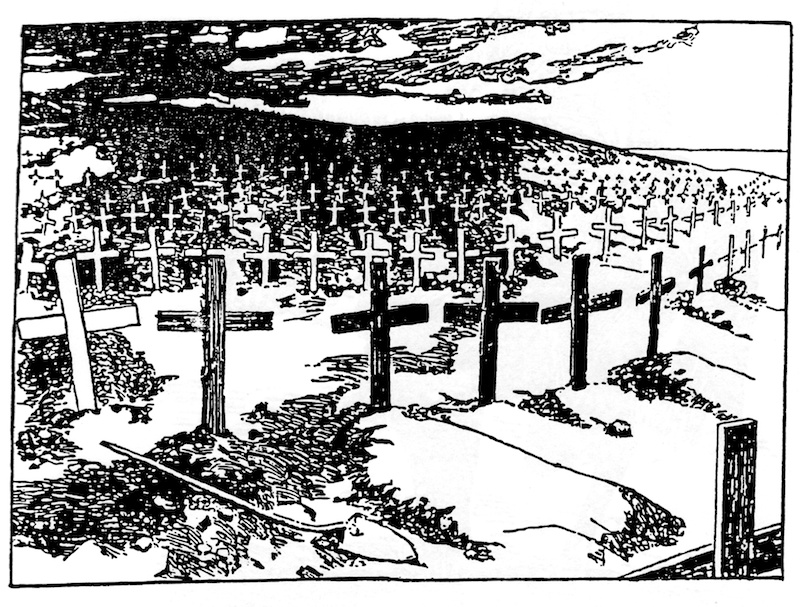
WHERE THEY LIE BURIED AT CAMP WIKOFF
——————
THE LAST BATTLEFIELD OF THE SPANISH AMERICAN WAR
More than 340 soldiers died at Camp Wikoff from tropical diseases — malaria, yellow fever, typhoid, dysentery — contracted in Cuba — and some from exhaustion (malnourishment — Army Beef Scandal of 1898).
The first soldier to die in camp was J. Knox Green of Troop C, Rough Riders, a wealthy ranchman from Gonzales, Texas. The doctors said he died of malarial fever, but hospital attendants said it was yellow fever. An unknown soldier also died just as the transport Mattewan docked at the Iron Pier — five more unknown soldiers would die during the encampment.
The soldiers that died at Camp Wikoff were returned to their hometowns for their final burial, except for approximately 50 who were re-interred at the National Cemetery, Cypress Hills, Brooklyn.
—- The World, page 87.
——————
Note: the Army Beef Scandal of 1898 (‘Embalmed Beef ‘ Scandal), was not recognized until the fall of 1898 — after it had been determined that the canned roast beef, supplied to the soldiers, was bad, causing soldiers to avoid eating it or to eat at their own risk; consequently, a number of soldiers grew weaker, making them more vulnerable to tropical fevers. If they died of malnourishment, the cause of death was listed as ‘exhaustion’, out of fear of Army discipline if listed as starvation.
On September 10th and in November, Col. Roosevelt sent reports on the poor quality of the canned roast beef to Sec. of War Alger and the War Commission Board, respectively — pages 528 – 529.
More soldiers died at Camp Wikoff than at San Juan Hill.
——————

Republican Gubernatorial Candidate Theodore Roosevelt at Carnegie Hall, October 5, 1898
——————————————
“They were American soldiers, no more and no less. Living, each one strove incessantly to do even more than his duty, scorning to do less, and ashamed to falter or ask for aid; yet, always glad to help a brother who, however willing, was weaker. Dying, each faced with equal courage the fate which, in an instant of time, blots out all the differences that we rear with such infinite labor on this earth. Living and dying, they gave us a lesson in American citizenship, and this lesson which they taught in the war, let us profit by as we live in peace.”
——————————————

— Pages 427 – 441 / New York Times, The Sun, The World, Commercial Advertiser, New York Press | Top illustration by Carter, The World | Bottom illustration by W.H. Shindler, New York Press
——————

Our Rough Rider Visitors.
Every quarter echoes with the hum of ranch and range, of gold gulch and the trail.
Men from the Staked Plains and the Mojave Desert stand up with the stoop-shouldered clerks from Wall Street.
— The World, page 366 / Illustrator, Williams.
————————————-
“Teddy’s Terrors,” mildest of men, despite their awe-inspiring nom de guerre, have seen New York and are ready to go home….They had come back from war covered in glory, had seen the biggest town on the country’s map, and had retained all their old love for their rough and free home life.
“I ain’t got no use for a place like this, where everybody is touching elbows and the air is full of smoke. Give me the range, with the grass waving in the wind, the great white mountains over yonder, and nothin’ in sight but a bunch of cattle here and there. That suits me fine,” said a great, blue-eyed six-foot-four cowpuncher as he leaned against an onyx and brass bar…
——————-
New York has found the Rough Riders soft-tongued, mild-mannered boys, civil to the last word
and with a sturdy courtesy as winning as it is unhewed.
— “Teddy’s Terrors Visit New York,” Winfield M. Thompson, Boston Globe, pages 365 – 367.
— The World / Illustrator Williams.
~~~~~~~~~~~~~~~~~~~~~~~~~~~~~~~~.

Teddy, The Golden Eagle
Teddy, an eagle, was taken up to the Central Park Zoo yesterday and turned over ot the city. Rough Rider Kennedy handed a note to Superintendent Smith:
“This is the golden eagle (the Indians call it ‘War Eagle’) which the Rough Riders had as their mascot. Just at this moment they have no place to keep him. Will you keep him for me? Will arrange terms later.”
— Theodore Roosevelt
Supt. Smith called Keeper Snyder, and told him to put the bird in the eagle house….the keeper led the way to the cage, Kennedy still carrying his pet. The big man looked troubled; as he walked along, he petted and praised the bird, and the bird seemed to understand.
Snyder opened the door to the cage, and Kennedy handed over the eagle. Just as Snyder was about to let it go, Kennedy ran forward. He picked it up again and hugged it.
“Good-by, old fellow,” he cried, tears breaking from his eyes. “Good-by!” ….
“I just natcherly couldn’t help it,” he said, half apologetically.
It was an affecting sight, to be sure, to see the brave fellow bidding adieu to the broad-winged monarch of the air.
— The World / Illustrator Carter / page 352.
~~~~~~~~~~~~~~~~~~~~~~~~~~~~~~~~
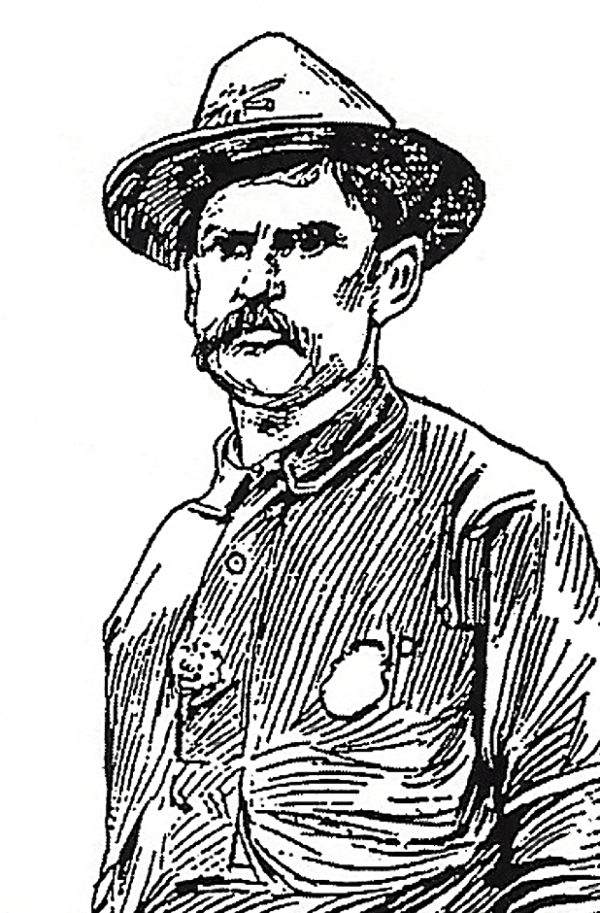
Rough Rider Bill Woods
“Say, partner, nobody ain’t got no use for a horse that can unseat Bill Woods,”
said Rough Rider Ash, himself a great cowpuncher.
— Boston Globe, page 375.
~~~~~~~~~~~~~~~~~~~~~~~~~~~~~~~~

Perry Tiffany bought his brother’s sorrel at auction for $ 45.
— Classified ad, New York Herald, page 378 | Tiffany” Horse, The World, page 379
~~~~~~~~~~~~~~~~~~~~~~~~~~~~~~~~
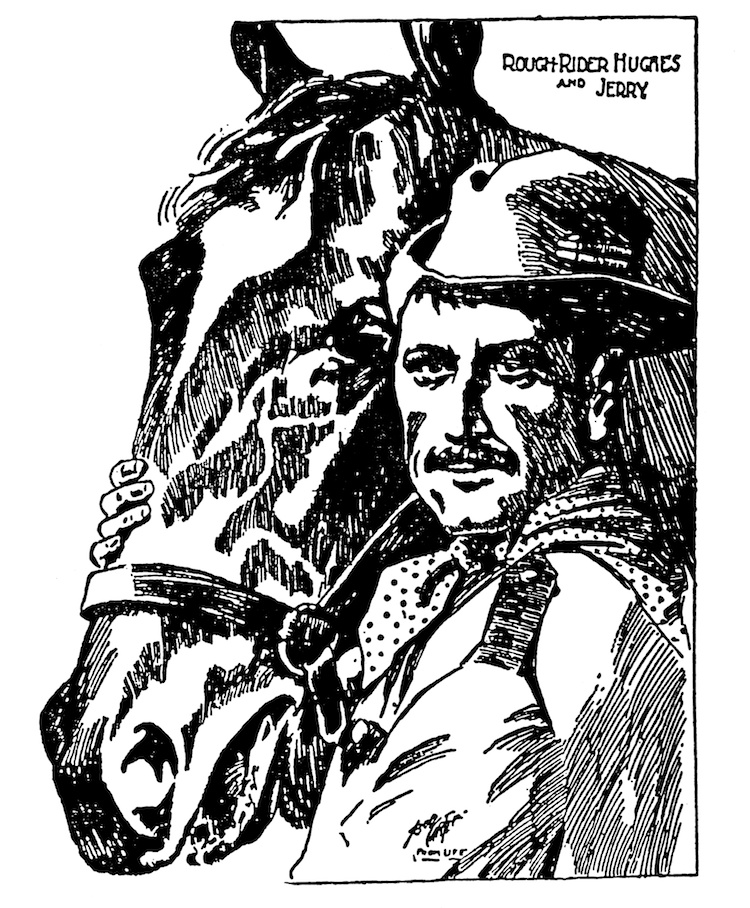
Private Hughes of Troop L bid on his horse for $ 13.
There was little competition for it was a roan, about fifteen hands high,
and appeared to be a good deal worse for hard usage and scanty food.
Nevertheless, Hughes was delighted when his old mount was knocked down to him,
and he put his arm affectionately about the animal’s neck as he led him away.
— The World, page 380 / Illustrator Carter.
~~~~~~~~~~~~~~~~~~~~~~~~~~~~~~~~
Decline of the Cavalry
 …. The disappearance of the horse, or rather, of the man and horse taken together from the fields of war, will tend to remove from the profession of arms the little romance that still surrounds it. War without “le beau sabreur,” the “bold dragon,” the gay hussar” and cavaliers generally will be but a prosaic affair. The labors and consequently the honors of war will go the plodding infantryman who marches through the mud on his own proper feet to the designated line of formation, where he pumps death out of his magazine gun, or the artilleryman who calmly turns a crank and disseminates destruction….
— Kansas City Star, page 381.
~~~~~~~~~~~~~~~~~~~~~~~~~~~~~~~~

Assistant Secretary of the Navy
Colonel Roosevelt of the Rough Riders
Republican Gubernatorial Candidate
GOVERNOR, NEW YORK STATE
————————————–
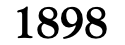
TREATY OF PARIS, December 10th
Defeat of the Spanish Empire
————————————–

~~~~~~~~~~~~~~~~~~~~~~~~~~~~~~~~~
EXTRA! EXTRA!
QUARANTINE IN MONTAUK
YELLOW FEVER! MALARIA! TYPHOID!
READ ALL ABOUT IT!
————————–

————————————–
CAMP WIKOFF …. A NEWSPAPER CHRONICLE
Amazon BULLY …. link
2nd Edition, 2023 / Published by the Montauk Historical Society & East End Press
with a Grant from the Gardiner Foundation
—————–
“A goldmine of information,” Dr. John Gable, 1998, Executive Director
Theodore Roosevelt Association
“‘BULLY!’ is as close to a time machine as one is likely to find between book covers,”
Author & Journalist, Russell Drumm review, East Hampton Star, 1998
_______________________________________________________

~~~~~~~~~~~~~~~~~~~~~~
Visit these Camp Wikoff portfolios / AAQ links:
Camp Wikoff — ‘BULLY! Col. Theodore Roosevelt, The Rough Riders & Camp Wikoff — 1898 …. link
Camp Wikoff: Gen. Shafter’s Victorious U.S. Fifth Army Corps / Montauk / Illustrated …. link
Spanish-American War, 1898 / Camp Wikoff / Timeline — Nation State to International Power …. link
Camp Wikoff Self-Guided Bike / Hike / Run / Ocean Swimming / Horseback Riding Historic tour …. link
~~~~~~~~~~~~~~~~~~~~~~~~~~~~~~~~~~~~~~~~~~~~~~~~~~~~~~~
