

Spanish-American War
TIMELINE
“A splendid little war, begun with the highest motives,
carried on with magnificent intelligence and spirit,
favored by that fortune which loves the brave.”— Secretary of State John Hay
~~~~~~~~~~~~~~~~~~~~~~~~~~~~~~~~~~~~~~~~~~~~~~~~~~~~~~~~~~~~~~~
———— February, 1898 ————
February 15th — REMEMBER THE MAINE — Battleship Maine explodes in Havana Harbor, Cuba, killing 260 men.
———— April, 1898 ————
April 11th — President William McKinley’s Letter To The Congress of the United States, “…. the destruction of the Maine, by whatever exterior cause, is a patent and impressive proof of a state of things in Cuba that is intolerable….” / President William McKinley’s Message to Congress, April, 1898 / BULLY, pp 509 – 513
———————————
April 22, 1898
SPAIN DECLARES WAR ON THE UNITED STATES
—————————————
April 25, 1898
UNITED STATES DECLARES WAR ON SPAIN
April 23rd — United States issues call for 125,000 Volunteers, including volunteers for Col. Leonard Wood’s First U.S. Volunteer Cavalry.
———————————
Modern Military Strategy Instructor John Joseph Pershing, West Point ’86, age 38, resigns his position at the United States Military Academy at West Point to join the war effort, having previous battle experience fighting in campaigns against the Apache and Sioux tribes in the Dakota Territory.
———— May, 1898 ————
May 1st — Battle of Manila Bay — Commodore Dewey destroys Spain’s Pacific Fleet
“You may fire when ready, Gridley” — Commodore George Dewey’s order to Captain Charles V. Gridley
———————————
May 6th — Assistant Secretary of the Navy Theodore Roosevelt, Harvard Class of 1880, age 39, resigns his position to join the war effort. Sec. of War Russell B. Alger offers Theodore Roosevelt command of the First U.S.Volunteer Cavalry — Roosevelt declines the position, recommending Col. Leonard Wood, who had battle experience and was a close friend. Wood, Harvard Medical School Class of 1884, was a Medal of Honor recipient (1885 Apache campaign against Geronimo).
—————————————————-
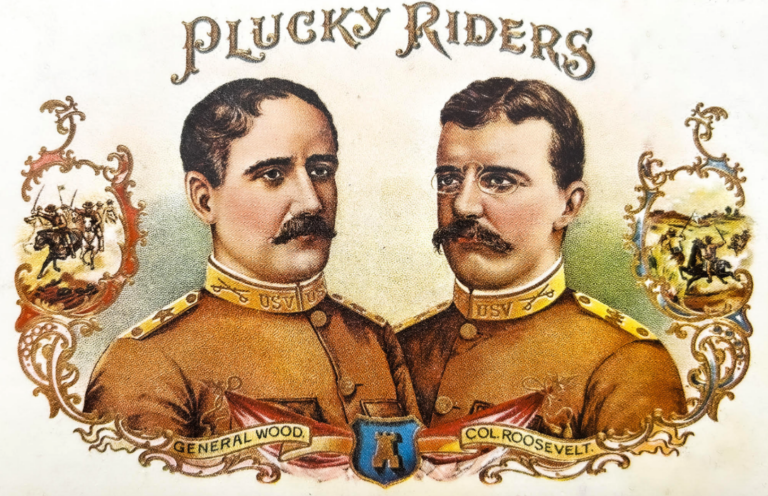
Cigar Box Illustration / courtesy of Theodore Roosevelt Collection, Harvard University.
———————————
May 16th — Lieut. Col. Theodore Roosevelt arrives in San Antonio to organize the First U.S. Volunteer Cavalry, which became popularly known as Roosevelt’s Rough Riders.
———————————
Gen. William Shafter named commander of the Fifth Army Corps, which included the First U.S. Volunteer Cavalry (1005 men).
———————————
May 29th — 1st U.S. Volunteer Cavalry Regiment leaves San Antonio by train for Tampa, arriving June 3rd.
=============================
———— June, 1898————
Marines of the United States Navy, under command of B.H. McCalla, following orders from Rear Admiral William T. Sampson, take the port of Guantanamo Bay, securing the port as a naval base.
———————————
June 13th — Eight companies of twelve 1st U.S. Volunteer Cavalry sailed to Cuba on the S.S. Yucatan, landing at Daiqui.
———————————
June 24th — 1st Volunteer Cavalry, under Col. Leonard Wood, takes part in the Fifth Army Corps’ first victory of the ground campaign against Cuba at Las Guasimas.
———— July, 1898————
July 1st — San Juan Hill — Colonel Theodore Roosevelt led a charge at the blockhouse on San Juan Hill that drove the Spanish from their fortified position, ultimately resulting in a decisive victory in Santiago de Cuba. The First U.S. Volunteer Cavalry was supported by the 9th and 10th Cavalry, popularly known as Buffalo Soldiers. Lieut. Col. James Joseph ‘Black Jack’ Pershing was in command of the 10th Cavalry, Buffalo Soldiers / BULLY — For an eye-witness account of the Charge, see War Correspondent Richard Harding Davis / New York Herald’s report pp 520 – 521.
“No one who saw Roosevelt take that ride expected he would finish alive. As the only mounted man, he was the most conspicuous object in range of the rifle pits, then only two hundred yards away. It looked like foolhardiness, but, as a matter of fact, he set the pace with his horse and inspired the men to follow ….” / BULLY — “Dashing Bravery of the Rough Riders / Their Splendid Charge Inspired the Army”, Richard Harding Davis, New York Herald, pp 520 – 521.
“All wondered how they had done it; it was against all modern military theory that men should charge straight at a fortified and intrenched position …. Only American valor could have done it.” Lieutenant John J. Pershing / BULLY, pp. 522 – 523.
Col. Roosevelt said of Captain John J. Pershing that he was “the coolest man under fire I ever saw in my life.”
———————————
July 3rd — BATTLE OF SANTIAGO DE CUBA — United States naval fleet, led by William T. Sampson and Winfield Scott Schley defeats the Spanish fleet.
———————————
July 17th — Spanish forces, under command of General Jose Toral, capitulates to U.S. General William Shafter / BULLY, p 514 – 515.
———————————
July 24th —“….this idea of nominating Roosevelt being taken in a serious way is amusing…Why, the chief objection of Platt to Black has been his independence….Now, Roosevelt in his impetuous way and in his strong self-assertiveness would not listen to any part suggestion….He would be absolutely master of the situation….He has shown this in every position he has held….You may be quite certain that Roosevelt will not be [nominated].” New York City Republican who stands close to Republican Party Boss U.S. Senator Thomas C. Platt / BULLY, ‘No Governorship for Col. Roosevelt’, Brooklyn Daily Eagle, opposite Page 1. Note: incumbent Republican Governor Frank Black was seeking re-election in 1898.
———— August, 1898————
August 4th — “….This army must be moved at once or perish….Our opinions are based on the unanimous opinion of our medical officers….” / BULLY, ‘Petition to General Shafter’, New York Evening Journal, page 15 and ‘That Round Robin Was Really a Revolt’, New York Journal, pp 196 – 200.
August 4th — “Army will die like sheep” — Col. Theodore Roosevelt’s Letter accompanying Petition to Gen. William Shafter … / BULLY, William Randolph Hearst’s New York Evening Journal, pp 13-14.
———————————
August 8th — Six hundred members of the Sixth United States Cavalry arrive by train at Montauk Station, and with their arrival the tent city encampment at Montauk formally opens / BULLY, First Troops at Montauk / New York Times, pp 39 – 40.
———————————

August 11th — President McKinley designates the military encampment at Montauk Point as Camp Wikoff / BULLY — New York Press, McKinley Honors Wikoff’s Heroism, p. 46.
Note: The ‘tent city’ established in Montauk became a Quarantine Camp, as soldiers returned from Cuba suffering from malaria and yellow fever. At that time, however, it had not been conclusively shown that mosquitoes transmitted either malaria or yellow fever. They were considered contagious diseases during the great encampment.
———————————
PEACE PROTOCOL
———— President McKinley Signs Peace Protocol ————
August 12th — “Now, therefore, I, William McKinley, President of the United States, do, in accordance with…the protocol, declare and proclaim…a suspension of hostilities… / BULLY, The War is Over, Spain Quits the New World / The Sun & New York Press, pp 50 – 51.
———————————

— BULLY / Joseph Pulitzer’s The World, August 15, 1898
———————————
August 13th — The Gate City, first transport from Santiago de Cuba, arrives home at Fort Pond Bay / BULLY, ‘507 Heroes Home From Santiago’ / The World & The Sun, pp 55-56.
———————————
August 15th — General Joseph Wheeler, Colonel Theodore Roosevelt debark from the Transport Miami at the Iron Pier, Fort Pond Bay / BULLY, ‘Roosevelt and Wheeler Ashore’ / New York Herald, The Sun, pp 60 – 68.
“Oh, but we have had a bully fight!”
———————————

Gen. Joseph Wheeler and Col. Theodore Roosevelt / BULLY, New York Herald.
—————————-
August 18th & 19th– Col. Roosevelt stays overnight at Third House before leaving Camp Wikoff on a four-day furlough to Sagamore Hill, Oyster Bay / BULLY, ‘A Civilized Bed’ / New York Times, page 91.
August 19th — The huge Transport Mobile anchors in Fort Pond Bay. Eight soldiers of the Second Massachusetts had died on the voyage home and were buried at sea / BULLY, ‘DEATH SHIP’ / The World, Boston Globe, The Sun, pp 95 – 98.
August 19th — General Wheeler, West Point 1858, assumes command of Camp Wikoff (thru September 7th). General Wheeler served as a General in the Confederacy, then as a General in the United States Army, one of only four Generals to do the same.
August 20th — Representative Lemuel E. Quigg meets with Roosevelt at Third House to discuss the developing political situation. / BULLY, ‘Platt’s Emissary Visits Roosevelt’, New York Herald, page 99.
August 22nd — At Sagamore Hill, Roosevelt breakfasts with James Roosevelt. In the afternoon, he meets with Secretary of State John H. Palmer of Albany / BULLY, Col. Roosevelt Gets Little Rest, The Sun, pp 105 – 106.
———————————
August 23th — Tropical storm sweeps over encampment on the night of August 23rd, blowing down tents, stampeding horses / BULLY, Storm in Camp / Three Dead, The Sun, pp 115 – 118.
———————————
August 24th — At Sagamore Hill, Col. Roosevelt & Senator Henry Cabot Lodge discuss the developing political situation in New York / BULLY, Roosevelt Going Back to Camp, New York Herald, pp 121 – 122.
———————————
“We have everything,” said a young lieutenant. “We have life and we have death” / BULLY, Commercial Advertiser
———————————
August 25th — Lieut. William Tiffany, an officer in Roosevelt’s Rough Riders, dies of starvation at the Parker House in Boston / BULLY, ‘Lieutenant William Tiffany’, New York Times, page 129 and ‘Lieutenant Tiffany’s Real Starvation’, November 19th, New York Journal, pp 527 – 528.
———————————
“There is a peculiar element of sadness in the fate of these young fellows,
who have reached the shore for which they longed, only to die.”
— Colonel Theodore Roosevelt / BULLY, ‘A Man of Dauntless Courage’, The Sun, page 130.
———————————
August 26th — Auxiliary Cruiser Prairie, in a heavy fog, runs aground on a sandbar between Amagansett and Napeague Beach. Local residents help bring the men to shore / BULLY, ‘Sick Land in Surf Boats’, The Sun, pp 133 – 138.
———————————
August 28th — Col. John Jacob Astor’s yacht Nourmahal delivers $ 3,000 worth of supplies and the ‘choicest delicacies’ to Camp Wikoff / BULLY, ‘Help For Montauk Troops’, New York Times, pp 146 – 147.
———————————
August 28th — There are now 1,610 patients in the General Hospital and 520 patients in the Detention Hospital / BULLY, ‘Caring for 2,140 Sick’, The Sun, page 168.
———————————
August 31st — Transport Allegheny arrives at Fort Pond Bay with 480 soldiers on board. Fourteen soldiers died on board during the voyage and were buried at sea / BULLY, ‘Floating Hell’, Boston Globe, The World, pp 191 – 195.

August 31st — Military Order of the Rough Riders organized — to be known as ‘Roosevelt’s Rough Riders’ — with Lt. Col. Alexander Brodie, a West Pointer, chosen as its President, and with Brig. Gen. Leonard Wood and Colonel Theodore Roosevelt chosen as Vice-Presidents / BULLY, ‘Military Order of the Rough Riders’, The World, New York Times, pp 200 – 201.
———— September, 1898————
September 1st — Major-General William Shafter arrives at Fort Pond Bay on board the steamship Mexico / BULLY, ‘General Shafter Lands at Montauk’, The World, pp 213 – 214.
———————————

Archival map of Camp Wikoff — the 4,000-acre quarantine encampment, September, 1898. Courtesy of the Montauk Historical Society.
———————————
MONTAUK’S GREAT DAY

“I bring you the gratitude of the nation, to whose history you have added by your valor a new and glorious page. You have come home after two months of severe campaigning, which has embraced assault, siege and battle – so brilliant in achievement, so far-reaching in results as to earn the unstinted praise of all your countrymen.”
September 3rd — President William McKinley tours Camp Wikoff, visiting the hospitals, addressing the troops — welcoming them home and congratulating them on their victories and thanking them for their service / BULLY, ‘Montauk’s Great Day’, New York Times, The Sun, New York Press, New York Tribune, pp 238 – 248.
———————————
September 4th — ‘May the new Cuba that is to come be worthy of its grand sacrifices and of the great American republic that has made it possible.’ / BULLY. ‘Cuba’, Editorial, Boston Globe, page 251.
———————————
September 4th — At the Sunday service, Col. Theodore Roosevelt delivers his first Bully Pulpit / BULLY, ‘Roosevelt’s Sermon’, Brooklyn Daily Eagle, The Sun, New York Herald, The World, pp 262 – 265.
“Our trials, our hardships, our victories, we have all shared together, officers and men.
We have all worked for and accomplished the glory of the regiment.”
———————————
September 7th — Major-General Joseph Wheeler assumed command of the cavalry division of the Fifth Army Corps, resigning command of Camp Wikoff and moving his headquarters to Ditch Plains. General William R. Shafter assumes command of the camp / BULLY, ‘Gen. Wheeler’s New Quarter’, Brooklyn Daily Eagle, pp 282 – 283.
———————————
September 7th — Naval Cadet Thomas H. Wheeler, youngest son of Gen. Joseph Wheeler, drowns off Ditch Plains in an effort to save his friend Lieut. Kirkpatrick / BULLY, ‘General Wheeler’s Son Lost’, The Sun, pp 289 – 292.
———————————
September 10th — Col. Theodore Roosevelt announces that he would accept the Republican Gubernatorial nomination if offered to him / BULLY, Brooklyn Daily Eagle, pp 314 – 315.
———————————
September 10th — Hospital ship Missouri arrives at Fort Pond Bay with 249 sick on board. Thirteen had died of typhoid fever during the voyage and were buried at sea / BULLY, New York Herald, page 296.
———————————
September 10th — Army Beef Scandal of 1898 — Col. Roosevelt’s Testimony: “The canned roast beef was coarse, stringy, tasteless, and very disagreeable in appearance, and so unpalatable that the effort to eat it made some of the men sick. Most of the men preferred to be hungry rather that eat it….” / BULLY, Congressional Hearing, pp 528 – 529.
Note: A number of deaths at Camp Wikoff were recorded as ‘exhaustion’ in the Register of Deaths, when they were caused by malnourishment, known as ‘inanition’, but fear of Army discipline resulted in ‘exhaustion’ listed as cause of death in the Death Register, rather than ‘inanition’ or starvation, which would have reflected poorly on the Army itself. / BULLY, The World, ‘Mute Evidence of Starvation’, pp 176 – 177.
———————————
September 13th — Col. Roosevelt bids the Rough Riders farewell, telling them,
“You cannot imagine how proud I am of your friendship and regard.”
In appreciation of his leadership, the Rough Riders give him Frederic Remington’s Bronco Buster statue / BULLY, ‘Roosevelt’s Farewell’, The Sun, pp 323 – 326.
———————————
September 13th — The Vigilancia, the last of more than 40 transports from Cuba, arrives at Fort Pond Bay with 241 on board. Three had died on board during the voyage and were buried at sea / BULLY!
———————————
September 14th — The Rough Riders and Colonel Roosevelt are mustered out of service. Roosevelt leaves Camp Wikoff by train at 9 PM bound for Oyster Bay. He is accompanied by Lieutenants John C. Greenway, John A. McIlhenny, Charles Ballard and Hal Sayre, who are to be his guests at Sagamore Hill / BULLY, ‘Colonel Roosevelt Mustered Out of Service’, Brooklyn Daily Eagle, pp 341 – 342.
———————————
September 17th — Colonel Roosevelt meets with Republican Party Boss, Thomas C. Platt, at the New York Hotel and receives his endorsement / BULLY ‘Roosevelt Meets Platt’, The World, New York Herald, New York Tribune, New York Times, pp 358 – 365.
———————————
September 19th — 8,000 soldiers remain in Montauk of the 29,500 soldiers that had arrived at Camp Wikoff since it was established / BULLY, ‘8,000 Men at Camp Wikoff’, The Sun, page 377.
———————————
September 21st — Col. Roosevelt is honored with a Peace Jubilee in Oyster Bay and tells of his ‘Crowded Hour’ at San Juan Hill / Bully ‘Peace Jubilee’, New York Times, Boston Globe, New York Herald, pp 382 – 391.
———————————
September 24th — Incumbent Republican Governor Black, seeking re-election, claims that Roosevelt is ineligible to run for Governor of New York State, produces document that Roosevelt signed in March, in which Roosevelt stated he was a resident of Washington, D.C. Gov Black’s claim supported by NYS Constitutional Lawyer, Edwin Countryman / Bully, ‘Black Hurls Bombshell’, New York Herald, pp 395 – 396. And, ‘Roosevelt Held Ineligible’, New York Press, pp 400 – 401.
———————————
September 26th / Saratoga — Governor Black tries to convince delegates to the Republican Convention that Roosevelt, if nominated, would ultimately be found ineligible to run / BULLY, ‘Black Surprises His Enemies’, New York Herald, pp 406 – 407.
———————————
REPUBLICAN STATE CONVENTION
Sagatoga, September 27th
‘HOW ROOSEVELT SWEPT THE FIELD’

“…. For this year, for this crisis, for the voters of the Empire State, for the young men of the country and the upward, onward and outward trend of the United States, the candidate of candidates is the hero of Santiago, the idol of the Rough Riders – Col. Theodore Roosevelt.” – Orator Chauncey M. Depew
——————
“….It was not his intention to abandon his home, the state of his birth, home of his father and his father’s father, the State that had showered honors upon his father and had more honors in store for him, where he built a home, to which he took his young wife and where his children were born, the State of his nativity, of his ambition and his pride….” – Lawyer Elihu Root
~~~~~~~~~~~~~~~~~~~~~~~~~~~~~~~~
September 27th — Following a nominating speech by Chauncey Depew and defense of Roosevelt’s NYS residency by Elihu Root, Theodore Roosevelt was unanimously elected as the Republican Gubernatorial Candidate at the Saratoga Republican Convention / BULLY, ‘How Roosevelt Swept The Field’, New York Herald, Commercial Advertiser, pp 411 – 421. Illustration by Mortimer, The World.
———— October, 1898————
October 2nd — Episcopal Church service held on one of the highest knolls in Montauk for those soldiers who had died at Camp Wikoff / BULLY, ‘ Sag Harbor Express, ‘A Beautiful Ceremony in Montauk’, pp 422 – 423.
—————-
NOTE: 340+ died at Camp Wikoff, more than at San Juan Hill. Many more would have suffered and died if not for the civilian volunteers who came to the aid of the fever-stricken troops, risking their own lives. Among the organizations that came to the soldiers’ aid: American Red Cross, Sisters of Charity, Women’s National War Relief Association, and East Hampton Relief Corps. Among the individuals: Howard Townsend — Southampton resident & Red Cross agent; Samuel Parrish — Southampton resident who spent several weeks at Camp Wikoff; Helen Gould who donated tens of thousands of dollars and visited the camp’s hospitals multiple times … Food delicacies and supplies were also donated by residents of East Hampton, Sag Harbor, Greenport, New Suffolk, Cutchogue, Bay Shore, Hempstead, New York City, among other communities on Long Island and in Connecticut and Rhode Island.
—————-
October 4th — On the veranda of Sagamore Hill, Colonel Theodore Roosevelt is notified of his nomination as the Republican Candidate for Governor of New York State / BULLY, ‘Notification Ceremonies at Oyster Bay’, New York Times, pp 425 – 426.
———————————

October 5th — Republican Gubernatorial Candidate Roosevelt launches his campaign with speech to a packed house at Carnegie Hall, saying,
“…The great lesson to be taught our people is the lesson of brotherhood and of self-help.
In our several ways each of us must work hard to do his duty; each must preserve his sturdy independence,
and yet each must realize his duty to others….”
BULLY, ‘Roosevelt Fires First Campaign Gun’, New York Times, The Sun, The World, Commercial Advertiser, New York Press, pp 427 – 441 | Illustration by Carter, The World, page 437.
———————————
October 9th — Secretary of War Alger orders the Seventh U.S. Infantry to transfer from Montauk to posts in Michigan. The Seventh leaves Camp Wikoff on October 14th / BULLY, ‘Camp Wikoff Abandoned’, The Sun, page 444 / ‘Seventh Leaves Camp Wikoff’, The Sun, page 445-446.
———————————
October 18th — Reubena Hyde Walworth, daughter of Ellen Walworth, Director of the Women’s National War Relief Association, dies of typhoid fever in NYC, having contracted the fever while serving as a nurse in the Detention Hospital at Camp Wikoff / BULLY, ‘Reubena Hyde Walworth, Heroic Nurse’, The World, pp 446-447.
———— November, 1898————
November 8th — Roosevelt Victorious — whole Republican state ticket elected / BULLY, ‘Roosevelt Victorious’, New York Tribune, page 451.
———————————

War Hero to NYS Governor-Elect
November 9th — Republican Party Boss Thomas C. Platt expresses his gratitude for Roosevelt’s victory, saying,
“I know of no other man who would have been able to conduct the canvass he has made
without breaking down before the schedule was completed.”
BULLY, ‘Platt’s Gratitude’, Commercial Advertiser, page 453.
———————————
———— December, 1898————

December 10th — Treaty of Paris signed, ending the Spanish American War. Spain ceded Porto Rico, Guam and the Philippines (U.S. paid Spain twenty million in compensation). / BULLY, page 516 | ‘Spain Leaves the Western World’, New York Press Editorial, pp 517 – 518.
END OF THE SPANISH GLOBAL EMPIRE: 1492 – 1898
———————————
Spain Leaves the Western World
“After four centuries, in which she might have built up an empire that singly could have withstood the world combined against it, she goes out impoverished, defeated and discredited….Spain learned nothing in her 400 years of ownership of magnificent possessions….Hers was a policy of conquest and sequestration–not one of colonization and development….It was a passion for plunder that possessed her….Countries were looted for their treasure….Indian races conquered and slaughtered….Everywhere it was the gathering of loot that was the chief aim of the Spanish adventurer….The penalty of loss of revenue, of loss of prestige and of property, is the legitimate outcome of the course this once great nation pursued.” / BULLY! New York Press / Editorial, pp 517 – 518.
Note: The loss of its Empire caused a cultural and philosophic revolution in Spain itself, known as ‘Generation 98’.
———————————
PERSHING’S DOUBT
“We had entered the war to liberate Cuba, and we kept that promise … But the far more dramatic and internationally important development … the purchase of the Philippines, with a combined area of 115,000 square miles and an estimated population of 6,500,000 mostly Asiatic peoples, with traditions and religions different from our own, and located 5,000 miles away from our western seaboard, was a totally new policy for our country. Up to that time, we had been strictly an American state, keeping hands off affairs in Asia and Europe.
“Now, however, under President McKinley and John Hay, his Secretary of State, seconded if not largely influenced by a coterie of imperialists of which Theodore Roosevelt and Henry Cabot Lodge were the most active, we assumed a conspicuous position in affairs far afield. In short, out of war for the liberation of Cuba, we emerged as an international power with possessions, interests and policies on the other side of the world.”
John J. Pershing, My Life Before the World War, 1860 – 1917 / A Memoir / BULLY, page 519.
==================================================
———— February, 1899————
February 12th — “On the whole, it may be said, that Montauk Point was an ideal place for the isolation of troops that had been exposed to, or had, yellow fever, and for the recuperation of those greatly debilitated by malarial attacks of marked severity.” / BULLY, ‘Report of the War Commission’, New York Times, pp 456 – 459.
~~~~~~~~~~~~~~~~~~~~~~~~~~~~~~~~~~~~~~~~~~~~~~~~
January 16th, 2001 — President Bill Clinton posthumously awards Colonel Theodore Roosevelt the Medal of Honor for his actions during the Battle of San Juan Hill / BULLY / Medal of Honor Awarded to Col. Theodore Roosevelt, pp 524 – 525.
Note: January 6th, 1899 — “The Governor is convinced that …. the failure to award him a medal of honor will be Secretary Alger’s revenge for his part in the ‘Round Robin’ at Santiago.” / BULLY, ‘Colonel Roosevelt’s Reward’, New York Times, page 524.
~~~~~~~~~~~~~~~~~~~~~~~~~~~~~~~~~~~~~~~~~~~~~~~~


~~~~~~~~~~~~~~~~~~~~~~~~~~~~~~~~~~~~~~~~~~~~~~~~~~~~~
Related Portfolios / links:
BULLY! Colonel Theodore Roosevelt, The Rough Riders & Camp Wikoff, Montauk, NY — 1898 …. link
——————-
Echoing Through City Streets
EXTRA! EXTRA!
QUARANTINE IN MONTAUK
YELLOW FEVER! MALARIA! TYPHOID!
READ ALL ABOUT IT!
——————–

“A goldmine of information,” Dr. John Gable
Exec. Director of the Theodore Roosevelt Association
—————-
—————————————–

———————————
DONATIONS and/or RESOURCE PLATES
Art & Architecture Quarterly / East End is not a non-profit organization;
however, AAQ / East End posts 125+ press releases monthly of programs sponsored by the major non-profit cultural organizations on the East End, at no charge to those organizations.
AAQ /East End also posts exclusive portfolios on art, architecture & preservation, which require research & preparation, taking time & incurring expenses.
Donations would be greatly appreciated; or, taking a Resource Plate ad on the website.
Donate …. link
For Resource Plate ads, rates and options, please inquire info@aaqeastend.com
____________________________________________________________