
Camp Wikoff
National Military Park
PROPOSAL
Montauk, New York
1898
~~~~~~~~~~~~~~~~~~
Cause Célèbre
Editor’s Note: The Spanish-American War resulted in a major change in America’s foreign relations, which continue today. National issues relating to Cuba and Overseas Military Bases are on-going. Camp Wikoff, the great quarantine encampment in Montauk, also marked significant changes in the treatment of fever-stricken soldiers.
There are currently nine National Military Parks, all commemorating battles fought on the mainland. Camp Wikoff would be the tenth national military park and mark the transition from mainland wars to overseas engagements — Santiago de Cuba to Fort Pond Bay, Montauk — completing the national military park system as of this date.
====================================
CWNMP PRÉCIS
Overlay Park Concept: Proposal to establish an overlay national military park comprised of existing town, county & state parklands, in addition to proposal to create a Memorial Walkway — from Montauk Station to Fort Pond Bay — through undeveloped land with monuments, signage, dedicated benches w/ information Kiosk and bay overlook platform.
~~~~~~~~~~~~~~~~~~~~~~~~~~~~
PROPOSED SITES
- Fort Pond Bay — Proposed reconstruction of the Iron Pier, 1898.
- NEW BUILDING: Fort Pond Bay — Proposed — Spanish-American War Museum w/ Topographical Map of Camp Wikoff, Exhibit Space and Research Room
- NEW WALKWAY: — Proposed Memorial Walkway between Montauk Station & Fort Pond Bay w/ Welcoming Kiosk & overlook platform.
- Village Green — Proposed Monument to President William McKinley w/ signage & dedicated benches
- Shadmoor State Park — Proposed Monument to Veterans of Foreign Wars & Lieut. Pershing / Buffalo Soldiers, signage, dedicated benches.
- Ditch Plains — ProposedMonument to General Joseph Wheeler, daughter Red Cross Nurse Laurie and youngest son, Naval Cadet Thomas
- Rita’s Stables —Proposed Roadside Monument to Roosevelt’s Rough Riders — property site of first Bully Pulpit & Roosevelt’s Farewell Address
- Third House — Proposed Reconstruction of Barn, 1898, for CW Museum
- Montauk Point Lighthouse — Proposed Monument to the Veterans buried at sea on their return voyage from Santiago de Cuba
~~~~~~~~~~~~~~~~~~~~~~~~~~~~
PROPOSED EVENTS
- Third Weekend in April: Montauk Lectures by scholars & historians — Quarantine, Fifth Army Corps, Roosevelt’s Rough Riders…
- Month of May: Lectures Points West, by scholars & historians, scheduled at locations west of Montauk, available via Zoom: Spanish American War, Cuba Then & Now, Beef Scandal of 1898, Roosevelt & McKinley, Foreign Relations, Tropical Fevers, NYC Newspapers & Illustrators ….
- Third Weekend in September @ Third House: Re-enactors — McKinley, Roosevelt, Pershing, Gen. Joseph Wheeler and daughter Laurie, Captain Ambrose Higgins, Thomas C. Platt, and Mrs. Walworth — Demonstrations, Army Band, Army Wagon Rides & Horsebacking Riding
- Third Weekend in November — Major Annual Event on the Beach at Fort Pond Bay: Tribute to Civilian & Military Volunteers: Reading names of Fifth Army Corps Regiments, names of soldiers who died at Camp Wikoff. Names of Local & National Volunteer Organizations w/ soloist singing John Howard Payne’s ‘Home! Sweet Home!’ — popular on returning transports & at Camp Wikoff
~~~~~~~~~~~~~~~~~~~~~~~~~~~~
PROPOSAL SUPPORT (note: first proposal, 2001; second in 2012; and this, slight revision of the second, offered today: November 11th, 2025)
- “The plan, in many ways, in my opinion, is a good idea,” Dan Rattiner / Dan’s Papers — February 1, 2001:
- “We support your cause and encourage you to continue pursuing the project,” Brigadier General Patrick Finnegan Dean of U.S. Military Academy at West Point — March 4, 2008
- “…the Town should encourage Mr. Heatley in his efforts to see this important chapter in Montauk’s history recognized in a meaningful way.” —Editorial / East Hampton Press — July 4, 2012
~~~~~~~~~~~~~~~~~~~~~~~~~~~~
For updates — and / or to offer support for this Cause — please send inquiry to info@aaqeastend.com.
———————

~~~~~~~~~~~~~~~~~~~~~~~~~~~
====================================
CAMP WIKOFF NATIONAL MILITARY PARK
PROPOSAL / November 11, 2025
Full Proposal Update November 20, 2025
—————————-
In August & September, 1898, Gen. William Shafter’s Fifth Army Corps — America’s First Veterans of a War Fought Overseas on Foreign Soil — returned home at Fort Pond Bay, Montauk, on more than 40 transports directly from Santiago de Cuba, following its victory over Spanish forces in America’s land offensive against Spain in the Spanish American War.
22,500 Soldiers debarked at the Iron Pier, Fort Pond Bay, and 7,000 Soldiers from southern posts arrived by train at the Montauk Train Station, walking-distance from Fort Pond Bay.
Montauk Point had been chosen as the home port because of its northern latitude, deep water harbor, isolation and train connection. As more than half of the returning soldiers suffered from tropical fevers — yellow fever, malaria, typhoid, dysentery — as well as exhaustion from the campaign — a 500-bed General Hospital and a 250-bed Detention Hospital were constructed to care for the unexpectedly high number of fever-stricken soldiers.
The great encampment — designated Camp Wikoff by President McKinley — was established as a Quarantine Camp for the rest and recuperation of troops in preparation for the fall campaign against Havana.
—————–
For the soldiers and the people of the United States, this was a Homecoming, celebrated by soldiers on board the returning transports — Home! Sweet Home! — and by relatives, friends and patriots across the country.
~~~~~~~~~~~~~~~~~~~~~~~~~~~~~~

~~~~~~~~~
THE HOMECOMING @ FORT POND BAY
—————————————-
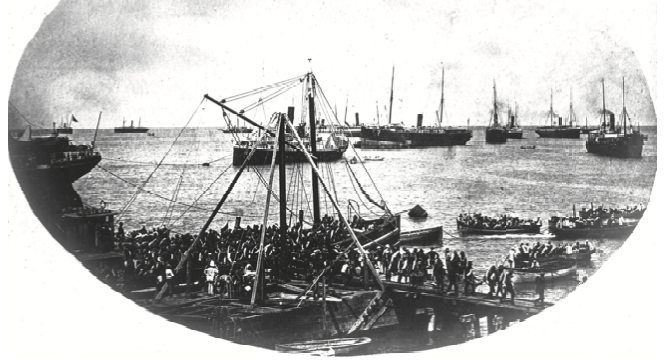
Transports, Mid-August, 1898, Fort Pond Bay
Courtesy of Theodore Roosevelt Collection, Harvard College Library / Emerson Photograph, cropped.
———————————
FORT POND BAY: THE HOMEPORT
Following an eight-day, 2,000-mile voyage, from Cuba, the sight of the Lighthouse at Montauk Point, promised a return to the homeland, and soon to each soldier’s hometown & home. Following a medical inspection of soldiers on the transports anchored in Fort Pond Bay, the men debarked at the Iron Pier to the cheers of soldiers on shore, relatives, friends and camp visitors. Gate City, the first transport from Cuba, arrived on August 13th — The Vigilancia, last of the more than forty transports from Cuba, arrived on September 13th.
General Joseph Wheeler, Colonel Theodore Roosevelt and the Rough Riders debarked from the Transport Miami on August 15th to the tumultuous cheers of thousands on shore, welcoming them home.
Standing on the transport’s bridge, alongside Gen. Joseph Wheeler, Colonel Roosevelt replied to an officer’s question shouted from the Pier, “How are you, Colonel Roosevelt?”
“I am disgracefully well….I feel positively ashamed of my appearance when I see how badly off some of my brave fellows are.” Then, after a brief pause, in tones of intense conviction,
“Oh, but we have had a bully fight!”
———
Proposed Reconstruction of the Iron Pier, 1898, originally built by the Long Island Railroad. A rail spur from the main line to Montauk Station was built onto the Iron Pier to accommodate train cars for the movement of supplies from the arriving transports.
Proposed Spanish-American War Museum at Fort Pond Bay: Topographical map of the great encampment as it was in 1898; Exhibit gallery; and Research Library.
—————————————-
Camp Wikoff Memorial Walkway
Tens of thousands soldiers, relatives, friends & visitors walked between the bay and station during the encampment. Proposed as a landscaped walkway, with a Kiosk displaying an archival map of the encampment, photos of the bay & station, and brochures. The CW Walkway would feature a monument to Gen. Shafter’s Fifth Army Corps — America’s first veterans of a war fought overseas on foreign soil — and have regiment-dedicated benches.
—————————————-

Montauk Station At Fort Pond Bay
Courtesy of Theodore Roosevelt Collection, Harvard College Library / Elemendorf Photograph, cropped.
———————————
Montauk Station
Secretary of War Russell B. Alger ordered 7,000 soldiers of the Fifth Army Corps to the 4,200-acre military camp at Montauk from southern posts, as many of those soldiers suffered from tropical fevers. On August 8th, 600 soldiers of the Sixth U.S. Cavalry arrived at Montauk Station. With their arrival the great military camp officially opened.
On September 3rd, President William McKinley, and his Presidential Party, which included Vice-President Hobart and Secretary of War Alger, arrived at Montauk Station, following an overnight stay in a Pullman Coach at Amagansett Station.
Ten of thousands of relatives, friends and visitors arrived by train — advertised as ‘Special Fast Trains’ — from Long Island City to Montauk in three hours during the encampment.
Tons of supplies were transported by rail, to and from, camp.
And, virtually the entire Fifth Army Corps departed Camp Wikoff by train — the Seventh Infantry, ordered to posts in Michigan, left on October 14th, effectively closing the great encampment.
During the Camp Wikoff’s brief existence, a village sprang up around the Station, which included Post & Express Package Buildings, Government Printing Building, Hungry Joe’s Restaurant, General Store, Army & Navy Officers Clubhouse, and a Power Plant (with Westinghouse Electric / Tesla Polyphase Induction Motor).
Signage: Montauk Station Village / Street map of buildings erected in 1898.
—————————————-
Montauk Village Green

New York Herald Illustration / James Gordon Bennett, Jr., Publisher, 1898.
—————
President William McKinley spent five hours touring Camp Wikoff, visiting with fever-stricken soldiers in the General Hospital and — although advised not to, given the quarantine — the Detention Hospital. He addressed 5,000 cheering troops on Montauk’s Great Plain, telling them,
“I bring you the gratitude of the nation, to whose history you have added by your valor a new and glorious page. You have come home after two months of severe campaigning, which has embraced assault, siege and battle — so brilliant in achievement, so far-reaching in results as to earn the unstinted praise of all your countrymen….
“All have served their country in its hour of need, all will serve it so long as they may be required, and all will forever have the thanks and regard of a grateful people….”
— President William McKinley, September 3, 1898.
—————
Sign / Dedicated Benches
Proposal: Monument to President William McKinley
—————————————-
Shadmore State Park
Proposal: Monument to Lieut. John J. Pershing & the Buffalo Soldiers
& Monument to the VFW / Signage & Dedicated Benches
 Given the poor conditions at Camp Wikoff — lack of cots, insufficient food, general neglect & quarantine — 13 veterans of the 17th Infantry Regiment — camped at what is now Shadmoor State Park — went on to form the American Veterans of Foreign Service in Columbus, Ohio, a forerunner of the Veterans of Foreign Wars. The VFW traces its deepest organizational roots to Camp Wikoff, celebrating its centennial in 1998.
Black Jack Pershing, age 38, in command of the 10th Cavalry — the 10th Cavalry supported the Roosevelt’s Rough Riders’ charge at San Juan Hill — arrived at Fort Pond Bay with his regiment on August 20, 1898. Note that Pershing attained the rank of ‘General of the Armies’ following his service in the First World War — the only General in U.S. history to be awarded that rank in his lifetime.
—————————————-
Site of the former Rita’s Stables
Col. Roosevelt and the Rough Riders camped at this site. Col. Roosevelt delivered his first Bully Pulpit to his men on Sunday, September 5th, and his Farewell on September 13th. Col. Roosevelt told his men,
 “….It gives me extreme pleasure to look around among you and see men of every occupation, men of means and men who work with their hands for a livelihood, and at the same to know that I have you for friends. You are men of widely different pursuits, yet you stand here side-by-side, you fought shoulder to shoulder. No man asked quarter for himself, and each one went in to show that he was as good as his neighbor. That is the American spirit.
You cannot imagine how proud I am of your friendship and regard…..”
In appreciation of his leadership, the Rough Riders gave him Frederic Remington’s bronze Bronco Buster statue.
————————
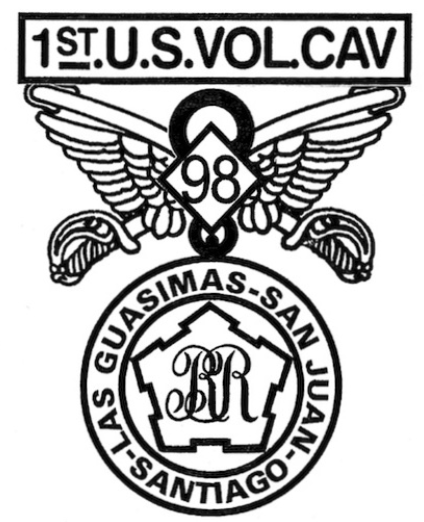 On September 13, 1898, the Military Order of the Rough Riders was organized at Camp Wikoff — with membership transferring to the eldest son on the death of the father.
The Commemorative Medal was designed by Lieut. Frederick Wingte of Company I, “an amateur artist of merit.” It bears the cross section of a bastion, the insignium of the Fifth Army Corps, and names the three battles that the Rough Riders fought in Cuba: Las Guasimas, San Juan Hill, and Santiago.
————————
Col. Roosevelt, while in service, had refused to discuss any political options in public; however, on September 10th — with the Republican Convention in Saratoga a few weeks away — he authorized a statement that he would accept the Republican Nomination for Governor, if offered to him.
Proposal: Roadside Monument to Roosevelt’s Rough Riders / Signage & Dedicated Bench.
———————-
Ditch Plains
Gen. Joseph Wheeler’s Second Headquarters was established here. On September 7th, tragically, his youngest son, Naval Cadet Thomas Wheeler, drowned off Ditch Plains, in his effort to save his friend, Second Lieut. Patrick Kirkpatrick, who was still recovering from a tropical fever contracted in Cuba.
The entire camp was devastated by the loss Gen. Wheeler’s son.
Proposal: Monument to General Joseph Wheeler, aide-de-camp Thomas Wheeler and Camp Angel Annie Wheeler.
—————————————-
Third House

Third House, New York Herald Illustration / James Gordon Bennett, Jr., Publisher, 1898.
Third House served as a headquarters and an inn for officers. On August 18 & 19th, Col. Roosevelt and his wife, Edith, stayed there. On September 7th & 8th, Edith with daughters Alice and Ethel stayed at Third House, while their sons, Ted and Kermit, camped in their father’s tent at the Rough Rider campsite, while the Colonel slept on the table.
On Friday, August 20th, Col. Roosevelt met with U.S. Representative Lemuel Ely Quigg, an emissary from the Republican Boss, Senator Thomas C. Platt, to discuss the political situation in New York as the incumbent Republican Governor, Frank Black, was seeking re-election.
—————
Proposed Reconstruction of Barn that stood near Third House in 1898
for use as a Rough Riders Museum. Wall tent platform camping w/ scheduled Veterans weekends.
—————

—————————————-
Montauk Point

Illustration, The World, 1898 / Joseph Pulitzer, Publisher.
The lighthouse was a beacon of hope for the returning soldiers. When sighted on the horizon, they knew they would soon be in “God’s country” again, and swarmed the deck to see the camp as the transport approached and rounded the Point. With many sick on the crowded transports, the soldiers knew at last that the torturous campaign & crowded transport voyage was near an end. Seeing the shores of Long Island, a soldier expressed the feeling of the men on board, when he said,
“I shall never forget this day as long as I live.”
Proposal: Sign & Monument to 60 soldiers who died on board the transports returning home from Santiago de Cuba
and who were buried at sea.
~~~~~~~~~~~~~~~~~~~~~~~

~~~~~~~~~~~~~~~~~~~~~~~~~~~~~~~~~~~
Three Annual Weekend Events Proposed
———————-
LECTURES APRIL & MAY
Lectures proposed for sites in Montauk on third weekend in April, and for sites west of Montauk in May thru Memorial Day Weekend.
Offered by Scholars, Historians and Authors at colleges, universities, historical societies, libraries & museums / available via Zoom.
—————–
Annual Lectures / April in Montauk / Suggested Topics
— Camp Wikoff / Quarantine Camp
— Fifth Army Corps
— Col. Roosevelt & The Rough Riders
— President William McKinley and the Presidential Party
— Gen. Wheeler / Laurie, Thomas & Joseph Wheeler
— Volunteers & Donors
— American Red Cross
— Col. Roosevelt, Lieut. Pershing & the Buffalo Soldiers
— Veterans of Foreign Wars (VFW)
— & More ….
———————-
Annual Lectures / May on Long Island / Suggested Topics
Offered by Scholars, Historians & Authors / Zoom
Historical Societies, Libraries,
Colleges & Universities / Nassau & Suffolk Counties
/ United States Military Academy at West Point
————
— Spanish Empire & the Spanish American War
— ‘Generation 98’ in Spain
— Lieut. Col.Theodore Roosevelt & the Medal of Honor
— President McKinley & Colonel Roosevelt
— General & U.S. Congressman Joseph Wheeler, Annie and Sons, Joseph & Thomas
— Lieut. John J. Pershing & Colonel Theodore Roosevelt
— Buffalo Soldiers
— Lincoln & McKinley Addresses
— Cuba / Then & Now
— Treaty of Paris, December 10, 1898
— Tropical Fevers: Malaria, Yellow Fever, Typhoid, and Dysentery
— Army Beef Scandal of 1898
— Newspapers in 1898: Yellow Journalism
— Long Island Volunteers at Camp Wikoff
— & More ….
———————-
RE-ENACTORS & DEMONSTRATIONS
THIRD WEEKEND IN SEPTEMBER @ THIRD HOUSE
Speech Re-Enactments
— Gen. Joseph Wheeler’s Introduction of President McKinley, September 3rd / page 244
— President McKinley’s Address to the Troops (Village Green), September 3rd / pages 245 – 246
— Colonel Roosevelt’s Bully Pulpit & Farewell Speeches (Third House), September 4th & 13th / pages 262 – 264 and 324 – 326
— Colonel Roosevelt’s ‘Crowded Hour’ Speech in Oyster Bay, September 21st / pages 385 – 391
— Chauncey DePew’s Speech Nominating Theodore Roosevelt for Governor of NYS, September 27th / pages 413 – 416
— Theodore Roosevelt’s First Campaign Speech / Carnegie Hall, October 4th / pages 434 – 441
————
Re-Enactors: President McKinley, Gen. Wheeler, Col. Roosevelt, Lieut. Pershing, Signal Corps Chief Ambrose Higgins,
Ellen Walworth, Annie Wheeler, and Senator Thomas C. Platt.
————
Demonstrations
— Army Band (popular songs), Bugle Calls
— Wigwagging / Heliographs / Telegraphs & the Morse Code
— Westinghouse Electric / Tesla Polyphase Induction Motor
Activities
— Army Wagon Rides to the Lighthouse, Horseback Riding, Biking, Hiking & Camping
———————-
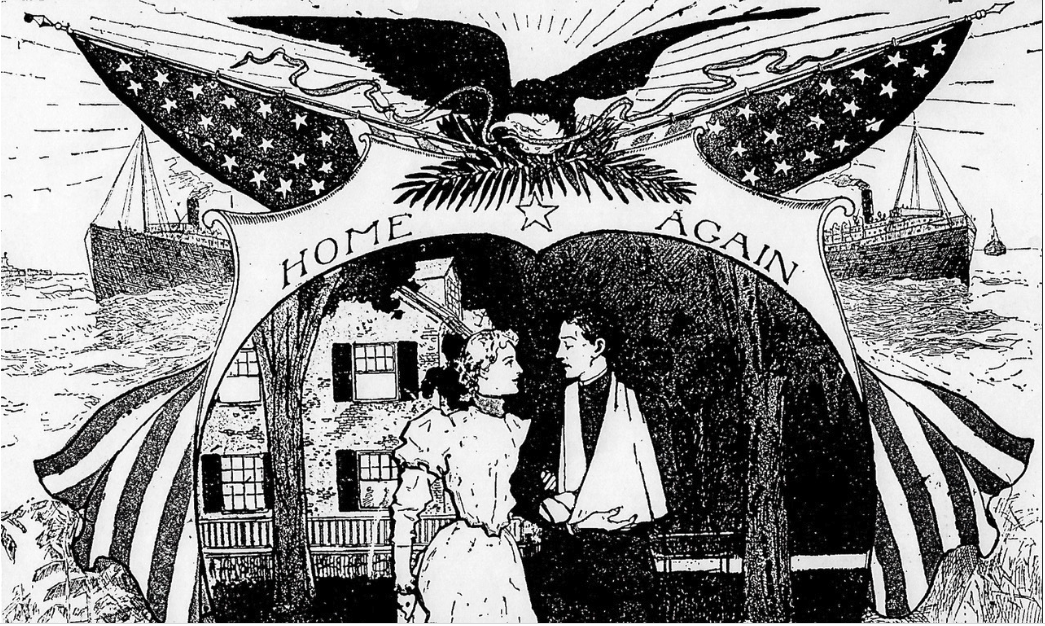
— Boston Globe / William O. Taylor, Publisher / August 21, 1898
THIRD WEEKEND IN NOVEMBER
@ FORT POND BAY BEACH
—————————–
Tribute
MILITARY & CIVILIAN VOLUNTEERS
HOMECOMING
————————–
“It seems to me that the two most striking features developed by this war are the heroism of our line
and the sacrifice and devotion to duty of trained women nurses in our hospitals.”
— Howard Townsend, Field Agent / American Red Cross — Report, 1898. Full Report, pp 530 – 537 / BULLY!
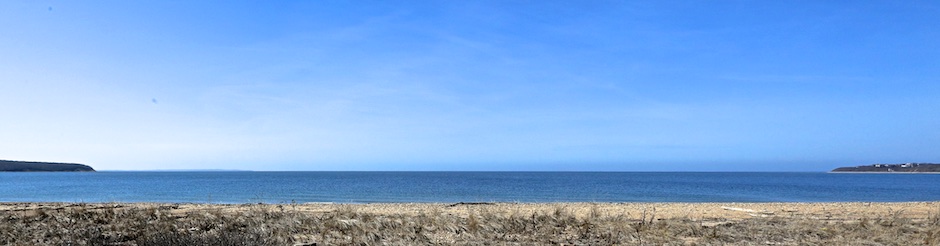
Beach @ Fort Pond Bay, Montauk
————
Tribute to Military Volunteers:
29,500 Troops of Gen. William Shafter’s Fifth Army Corps, including 1060 Soldiers of the 1st Volunteer Cavalry,
aka Roosevelt’s Rough Riders
— Reading of the Names of Transports & Regiments on Board w/ Arrival Dates
—————

More soldiers died at Camp Wikoff than at San Juan Hill.
— Reading of the name & cause of death of the 340+ soldiers who died at Camp Wikoff and the 60+ soldiers who died at sea on the transports from Santiago de Cuba. And, the names of the Red Cross nurses who died.
~~~~~~~~~~~~~~~~~~~
Tribute to Civilian Volunteers, Donors & Organizations:
American Red Cross
East Hampton Relief Corps
Women’s National War Relief Association
New York City, Connecticut, Rhode Island Hospitals
New York Merchants’ Association
Auxiliary Hospitals established in Amagansett, East Hampton & Sag Harbor
As well as Individuals
Nurses Annie Laurie Wheeler & Reubena Hyde Walworth (who died of Typhoid Fever in October)
Helen Gould
Col. John Jacob Astor
Cornelius Vanderbilt
Samuel Parrish….
Drs. F.P. Lolley and J. Finley of East Hampton
Dr. George E. Munroe, Vice President of the Maidstone Club
Mrs. L.G. Woodhouse, Mrs. T.L. Manson, Miss Julia A. Chadwick, Misses Hawthorne, Miss Carson of East Hampton
Mrs. Stewart Moore & others of New Suffolk
Miss Ella Wingate Ireland (a cousin of Gen. Wheeler), and other contributors from Greenport
Supplies donated by women in Hempstead
Supplies donated from Old Stonington, Connecticut ….
~~~~~~~~~~~~~~~~~~~~~~~~
Anecdotes of Civilian & Military Volunteers
~~~~~~~~~~~~~~~~~~~
— Solo Singing of John Howard Payne’s ‘Home! Sweet Home!’
— Bugle Calls: Assembly & Taps
~~~~~~~~~~~~~~~~~~~~~~~~~~~~~~~~~~~~~~
Proposal Endorsements
——————————
February 1, 2001
—– Dan Rattiner, Dan’s Papers —–
First CWNMP Proposal
Bully!
…. the author of a book about the Spanish-American War has petitioned the President to create a park in Montauk to honor the heroes of the Spanish-American War here. The letter, sent by Jeff Heatley, author of Bully! Colonel Theodore Roosevelt, The Rough Riders and Camp Wikoff, Montauk, was mailed on November 20, 2000, to President Clinton. The plan, in many ways, in my opinion, is a good idea.
1898, historians now say, is when America came of age, establishing itself as a great power in the world.
— Dan Rattiner, Editor & Publisher of Dan’s Papers / Feature Article, February 1, 2001.
——————————
March 4, 2008
—– United States Military Academy at West Point —–
Second CWNMP Proposal
This proposal received the support of Brigadier General Patrick Finnegan,
Dean of United States Military Academy at West Point
March 4, 2008.
“Camp Wikoff played an important role in the American war with Spain in 1898. In many ways the Camp reflected the spirit of the times, especially with regard to volunteerism and the Progressive impulse of the late-19th and early 20th centuries. Through its gates passed thousands of heroic Americans—military and civilian, famous and ordinary—whose commitment and sacrifice brought victory in the war. For these reasons and the many others you outline in the proposal, we support your cause and encourage you to continue pursuing the project.”
——————————
July 4, 2012
—– Editorial / East Hampton Press —–
Second CWNMP Proposal
Bully!
There wasn’t any opposition when the Suffolk County Legislature announced last month that it was changing the name of Theodore Roosevelt County Park back to its original name, Montauk County Park. But just a few days afterward, a small package from Jeff Heatley that arrived in this paper’s office gave reason for pause.
Now that the park’s name has been changed, Mr. Heatley, the author of a book about then-Colonel Theodore Roosevelt and his regiment, the Rough Riders, who convalesced at Camp Wikoff in Montauk following the Spanish-American War, wants to see the man who went on to become president and his men honored in another, more ambitious way: through the creation of a natonal military park in Montauk….
Mr. Heatley’s proposal is just a vision at this time, one without a budget or even a plan to raise funds. To become a reality, it would require the blessing of the National Park Service … While a national military park commemorating the Rough Riders’ might be a lofty goal … the town should encourage Mr. Heatley in his efforts to see this important chapter in Montauk’s history recognized in a meaningful way.
— Lead Editorial, East Hampton Press, July 4, 2012
==========================================================
Report of the War Commission
—– February 13, 1899 —–
“…..On the whole it may be said that Montauk Point was an ideal place for the isolation of troops who had been exposed to or had yellow fever, and for the recuperation of those greatly debilitated by malarial attacks of marked severity….
“….In concluding its labors, it is with much pleasure that the commission reports that notwithstanding the haste with which the Nation entered upon the war with Spain, the resulting and almost inevitable confusion in bureau and camp, the many difficulties of arming, assembling and transporting large bodies of hitherto untrained men, the carrying on of active operations in two hemisphere, the people of the the United States should ever be proud of its soldiers, who, co-operating with its sailors, in less than three months put an end to Spanish colonial power, enfranchised oppressed people, and taught the world at large the strength and nobility of a great Republic.
— New York Times
———————————————————–
Illustration, Chicago Tribune / Joseph Medill, Publisher
~~~~~~~~~~~~~~~~~~~~~~~~~~~~~~~~~~~~~~~
Echoing Through City Streets
EXTRA! EXTRA!
QUARANTINE IN MONTAUK
YELLOW FEVER! MALARIA! TYPHOID!
READ ALL ABOUT IT!
——————–
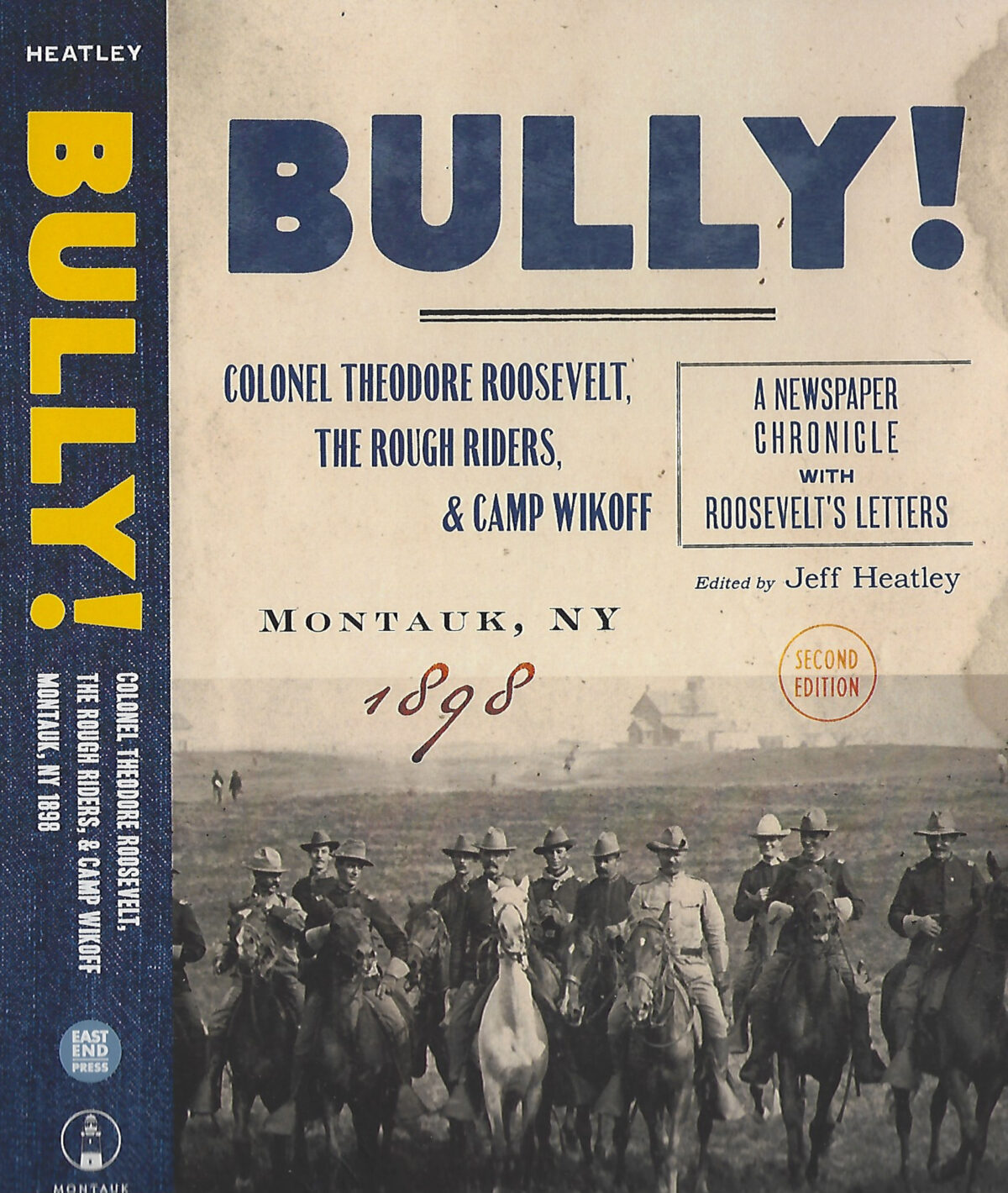
BULLY!
Colonel Theodore Roosevelt, The Rough Riders & Camp Wikoff, Montauk, NY — 1898
A Newspaper Chronicle / Edited by Jeff Heatley
Second Edition / Published by Montauk Historical Society & East End Press
w/ Grant from the Robert D.L. Gardiner Foundation, 2023
350+ Entries, 125+ Illustrations + 12 Roosevelt Personal Letters + 17 Archival Photographs
Available on Amazon …. BULLY! link
————————————–
—————
AAQ / Portfolio: Camp Wikoff, 1898: Self-Guided Bike, Hike & Run Historic Tour …. link
—– AND —–
Camp Wikoff Portrait Gallery thru August, 1898 …. link
Camp Wikoff Portrait Gallery September thru November, 1898 …. link
~~~~~~~~~~~~~~~~~~~~~~~~~~~~~~~~~~~~~~~~

Art & Architecture Quarterly / East End
— An Exclusive Portfolio —
w/ multiple Camp Wikoff portfolios — NYS Politics, Roosevelt Rough Riders, Quarantine, Newspaper Editorials, Lessons of War, Montauk Landscape ….
And,
______________________________________