History and Artistic Impact of Tarot
from the Renaissance through to Today
———————-
The Visconti-Sforza Deck—Now in the Collections of the Morgan Library & Museum and the Accademia Carrara, Bergamo—Will Be Reunited for the First Time in the U.S.
———————-
Also On View Is a New Commission by Contemporary Artist Chris Ofili
———————-
Tarot! Renaissance Symbols, Modern Visions
June 26 through October 4, 2026
The Morgan Library & Museum will present Tarot! Renaissance Symbols, Modern Visions, an exhibition in two parts that explores the origins of tarot in Renaissance Italy and its contemporary relevance as an enduring source of inspiration for twentieth- and twenty-first-century artists. The first part, Renaissance Symbols, focuses on the earliest surviving tarot decks from the fifteenth century, examining the rich court culture from which the cards emerged, the development of the cards’ imagery, and how that imagery became the basis for later divination practices. The second part, Modern Visions, traces artists’ engagement with tarot imagery during four distinct historical moments in which the occult assumed greater prominence within the larger culture, culminating in a new commission by renowned contemporary artist Chris Ofili. The exhibition will be on view from June 26 through October 4, 2026.
————
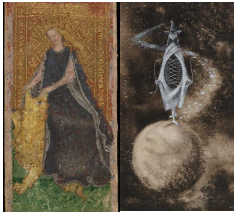
Left: Bonifacio Bembo (1420-1480), Strength/Fortitude, Visconti di Modrone Tarocchi, Italy, 1441–42. Beinecke Rare Book & Manuscript Library, Yale University. Right: Remedios Varo (Spanish, 1908–1963), El otro reloj (The Other Clock), 1957. Gouache on cardboard, 15 3/16 × 9 1/8 in. Private Collection, New York. © 2026 Remedios Varo, Artists Rights Society (ARS), New York / VEGAP, Madrid. Courtesy of Gallery Wendi Norris.
————
The impetus for this exhibition was the Morgan’s Visconti-Sforza Tarot cards, the most famous deck to survive from the Renaissance. The Visconti-Sforza deck was commissioned to commemorate the marriage of two powerful families in Milan, and was probably created by the artist Bonifacio Bembo. Tarot! reunites all the figural cards in the Morgan’s collection with those in the collection of Accademia Carrara, Bergamo, Italy, marking the first time the majority of the cards from this important deck will be displayed together in North America.
Originally created as a courtly game of skill, tarot was not associated with occult secrets, divination, or the power of fate until centuries later. By the twentieth century, the cards came to serve as a source of inspiration for artists, offering an alternative to the strictures of modernist aesthetics and allowing them to explore other universes and imaginative possibilities.
————
“Tarot! offers fresh perspectives on a popular and widely known subject through a uniquely art- historical lens,” said Colin B. Bailey, Katharine J. Rayner Director of the Morgan Library & Museum. “This exhibition marks the culmination of years of careful research into both the history and creation of a celebrated Renaissance art form and the broader history of tarot, tracing its influence up to the present day, where contemporary artists continue to draw on its imagery to create sublime works of art. The reunification of the Visconti-Sforza Tarot deck was made possible through the Morgan’s collaboration with the Accademia Carrara, Bergamo, and we are deeply grateful for their partnership.”
————
Renaissance Symbols
Renaissance Symbols focuses on the origins of the three earliest surviving tarot decks, organized across five thematic sections. “Tarot and Courtly Art” situates the cards within the visual culture of the Renaissance, presenting examples of textiles and decorative arts while examining the court culture from which the cards emerged. “From Triumph to Tarot” and “Tarot as a Game” trace the origins and development of the trick-taking card game and the evolution of its enduring imagery. “The Tarot Workshop” focuses on the production of the cards and the workshop practices that shaped their uniform visual identity. Finally, “Tarot and Divination” details how imagery from a card game became a tool for divination in the eighteenth century.
Renaissance Symbols places the cards within the visual tradition of fifteenth-century Italy. The cards draw on the rich symbolism of the time to create a game that features personifications of familiar allegorical figures like Love, Death, Fortune, Time, and Folly, while also incorporating theological virtues like Faith, Justice, and Temperance.
A highlight of the exhibition is the cards themselves, which are installed throughout. On view will be forty-five cards from the Visconti-Sforza deck from the Morgan’s and the Accademia Carrara’s collections, including all of the deck’s figural cards. The exhibition will also include cards from two other closely related decks: the Visconti di Modrone Tarot in Yale University’s collection and the Brambilla Tarot from the Pinacoteca di Brera, Milan.
While Europe during the Renaissance was familiar with astrology and
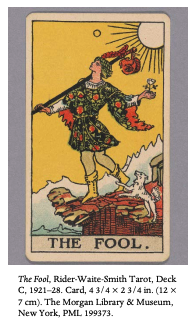
palm reading, there is no evidence that tarot served divinatory purposes until the eighteenth century. At that time, the Tarot de Marseille (ca. 1760) codified the visual traditions of the Visconti cards and established the format that would shape tarot imagery and practice for centuries, including the iconic Rider-Waite-Smith deck, created in the early twentieth century.
Modern Visions
Modern Visions examines four periods across the twentieth and twenty-first centuries—the British Occult Revival, Surrealism, the United States in the 1960s and 1970s, and the contemporary moment of the last ten years.

The Wheel of Fortune, playing card, illuminated by Bonifacio Bembo,
Italy, Milan, ca. 1450–80. The Morgan Library & Museum, New York, MS M.630, nos. 20, 32, 33. Photography by Graham S. Haber.
This part of the exhibition begins with “The British Occult Revival” and the 1909 Rider-Waite-Smith deck, conceived by mystic Arthur Edward Waite and illustrated by artist Pamela Colman Smith. The deck incorporates an extraordinary range of visual references, both from early twentieth-century British culture and from historical sources like the Tarot de Marseille and Renaissance decks. Smith democratized tarot by providing illustrations for each card, rather than just the twenty-two Major Arcana, as was typical. Modern Visions also features other critical figures of the British Occult Revival, including Aleister Crowley and Lady Frieda Harris, who created the 1930s hand-painted Thoth Tarot cards, along with lesser-known personages such as writer and artist Austin Osman Spare, whose deck, created circa 1906, was only recently discovered.
With the dissemination of the Rider-Waite-Smith deck, tarot became firmly entrenched in the popular imagination, and its influence can be seen in later practitioners including major artistic figures like Leonora Carrington, Niki de Saint Phalle, Betye Saar, and Remedios Varo.
“Surrealism” explores that movement’s growing interest in magic and the occult against the backdrop of artists’ disillusionment with government institutions and the rise of fascism in Europe. André Breton and his circle are examined, as are women artists like Leonora Carrington and Remedios Varo, who saw tarot as an alternative to patriarchal structures. This section seamlessly transitions into the section on the United States in the 1960s and ’70s, where artists like Bea Nettles, Marjorie Cameron, Jess, Niki de Saint Phalle, and Betye Saar explored countercultural themes and New Age spirituality.
The exhibition culminates with the early twenty-first century, wherein tarot’s ability to lend itself to diverse reinterpretations has made it a potent source of inspiration for artists confronting uncertainties and anxieties about the contemporary world. This section includes a broad sampling of contemporary artists working with tarot imagery in a variety of ways, both figurative and abstract. Artists include Elizabeth Colomba, Elijah Burgher, Ali Banisadr, Marcel Dzama, Alison Saar, and Kerstin Brätsch. Also included is a commissioned work by renowned British painter Chris
 Ofili in which he builds on a character called The Healer, which originated in a painting from 2008. Outside the galleries, in the Marble Hall, recent decks showcase the range of approaches to tarot today.
In 2016 and 2017, Maria Grazia Chiuri, then Dior’s Creative Director, designed two collections inspired by the Visconti-Sforza and Visconti di Modrone decks. One dress from the Dior Haute Couture Fall/Winter 2017 collection will be installed in the Marble Hall. Also included is a video reel of contemporary film and television clips featuring tarot in pop culture.
The Tarocchi Study Project
This exhibition honors a collaborative research project, conducted over several years across six cultural institutions, that compared the three oldest surviving sets of tarocchi (tarot) cards. The study began in 2021 and included conservators, conservation scientists, and curators from the Morgan Library & Museum; Yale University; the Metropolitan Museum of Art; the Art Institute of Chicago; the Center for Conservation and Restoration of Cultural Heritage “La Venaria Reale,” in Turin; the Accademia Carrara; and the Pinacoteca di Brera. Marking the first time these cards were subject to in-depth technical analysis, this project provided a deeper understanding of the cards’ materials and production, situating them firmly within the context of contemporary Northern Italian illumination. Throughout the exhibition, the Morgan will feature related articles about the project on its blog.
Organization
Renaissance Symbols is organized by Joshua O’Driscoll, Melvin R. Seiden Curator and Department Head of Medieval and Renaissance Manuscripts, and Francisco H. Trujillo, Drue Heinz Book Conservator. Modern Visions is organized by Claire Gilman, Acquavella Curator and Department Head of Modern and Contemporary Drawings, with Esther Levy, Curatorial Assistant for Modern and Contemporary Drawings.
Sponsorship
Tarot! Renaissance Symbols, Modern Visions is made possible by the Elaine and Alexandre Rosenberg Charitable Foundation; an anonymous donor, in memory of Melvin R. Seiden; Beatrice Stern; the Vasari Fund for Exhibitions; the William Randolph Hearst Fund for Scholarly Research and Exhibitions; and an anonymous donor. Generous support is provided by Alyce Williams Toonk; the Lucy Ricciardi Family Exhibition Fund; and Susanna and Livio Borghese, in memory of Agnes Gund; with additional support from Marguerite Steed Hoffman, Dr. Wendy A. Stein and Mr. Bart Friedman, and Rachel and Alex Stern.
Publication
The exhibition is accompanied by a major volume presenting valuable new information and context on how tarot has developed, evolved, and been reimagined by artists, mystics, and writers over the centuries—from its origins as a fifteenth-century Italian court game to its transformation into a tool for divination, artistic creation, and storytelling. The book fills a gap in published material on the history and artistic development of tarot, its symbolism, and its role as a source of inspiration for contemporary artists. An illustrated introduction plus six other richly illustrated essays explore the extensive history of tarot, its origins and iconography, and its occult and highly personal uses in spirituality and divination. The plates section features twenty-two spreads of tarot cards, comparing the same motifs across six centuries of artistic reinvention. Contributors include a number of Morgan staff, including Colin B. Bailey, Claire Gilman, Joshua O’Driscoll, and Francisco H. Trujillo, as well as Esther Levy, Curatorial Assistant for Modern and Contemporary Drawings, and Lydia Aikenhead, Assistant Book Conservator. The catalog is published by the Morgan Library & Museum in association with D Giles Limited and will be available beginning in June 2026 at the Morgan Shop for $44.95.
Programs
Tarot! Renaissance Symbols, Modern Visions is accompanied by a robust series of programs, including a panel discussion with the curators and other art historians on tarot’s place in art history on July 15; a performance by mentalist Matt Cooper on July 23; tarot readings during Free Fridays on June 26, July 17, and August 21; an online short course on tarot as a tool for divination and creativity on August 5 and 12; a workshop on learning to read tarot on September 10; and a scholarly symposium on September 18, featuring a discussion with curators and conservators about the techniques used to make fifteenth-century tarot cards for the court of the Dukes of Milan, as well as a lively conversation between curator Claire Gilman and artist Kim Krans, who will provide insight into a contemporary artist’s approach to creating tarot art.
~~~~~~~~~~~~~~~~~~~~~~~~~~~~
A museum and independent research library located in the heart of New York City, the Morgan Library & Museum began as the personal library of financier, collector, and cultural benefactor Pierpont Morgan. The Morgan offers visitors close encounters with great works of human accomplishment in a setting treasured for its intimate scale and historic significance. Its collection of manuscripts, rare books, music, drawings, and works of art comprises a unique and dynamic record of civilization, as well as an incomparable repository of ideas and of the creative process from 4000 BC to the present.
The Morgan Library & Museum | 225 Madison Avenue | 212-685-0008 |themorgan.org
————————–
Visit AAQ / Museum Architecture: The Morgan …. link
==========================================


AAQ / Resource
Stelle Lomont Rouhani Architects
===================================

AAQ / Resource:
Ben Krupinski Builder
========================================

AAQ / Resource: Riverhead Bay Motors
________________________________________________