
Proposal to Establish America’s Tenth National Military Park
Honoring Military & Civilian Volunteers
~~~~~~~~~~~~~~~~~~~~
Newsletter # 5 / July 15, 2026
~~~~~~~~~~~~~~~~~~~~
STATE OF THE UNION, 1898
~~~~~~~~~~~~~~~~~~~~
CIVILIAN VOLUNTEERS
———————————-
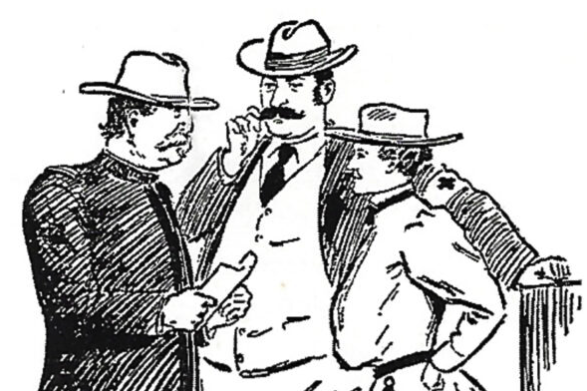
Col. Forwood, Red Cross Representative Howard Townsend,
and Red Cross Nurse Quintard
American Red Cross
As soon as the decision of the Government in regard to the formation of this camp became known …. the National Red Cross Relief Committee realized how much need there would be of Red Cross work, not merely at the hospitals, but among the regimental camps …. It seemed advisable that one of the Executive Committee should volunteer his services as Field Agent. As the writer’s home is at Southampton, twenty-five miles west of Montauk, it seemed to him clearly to be his duty to take the position.
On Sunday, August 6th, I went to Montauk ….
————
Illustration, left to right: Col. Forwood, Howard Townsend & Head Nurse Miss Quintard
August 9, 1898 | Illustrator W.H. Shindler / New York Press page 41
Report by Howard Townsend / 1898 | BULLY pages 530 – 537 .
———————————
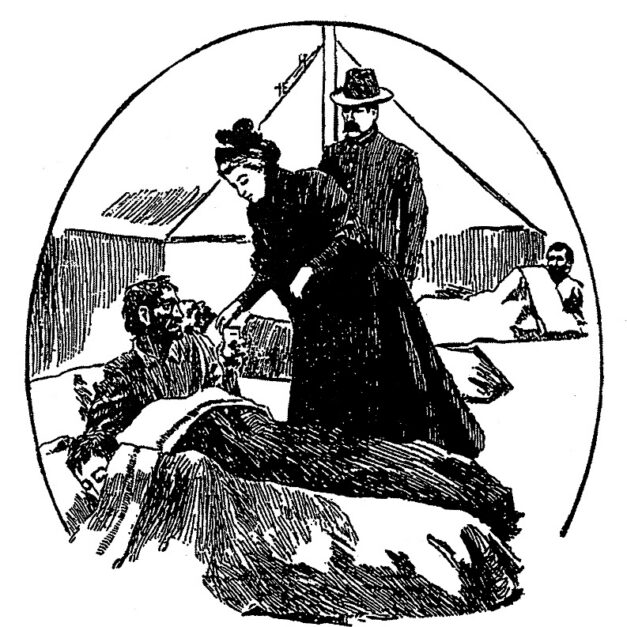
‘Camp Wikoff’s Brave Camp Mother’
Mrs. Ellen Hardin Walworth…gained distinction by driving twenty miles for twelve quarts of milk for sick soldiers who had been without nourishment for twenty – four hours…Her long trip was through a blinding Montauk mist in an open carriage. After she had seen the sick men refreshed by the milk she had brought, Mrs. Walworth had a four-mile drive in an open carriage in pouring rain.
— Pulitzer’s The World, August 12, 1898 — BULLY pages 50 – 51 | Illustration page 51.
Note: Ellen Hardin Walworth was one of the founders of the Daughters of the American Revolution. With Helen Gould and Mrs. General U.S. Grant, she founded the Women’s National War Relief Association on May 31, 1898.
———————————
 ‘Red Cross Heroine of Camp Wikoff’
General Joseph Wheeler’s daughter, Annie Early Laurie Wheeler, the only non-immune Red Cross nurse who went to Santiago….
“I expected to rest when I came north, but when I found the need so great, I felt like a fire horse at the sound of an alarm.
I could not rest with all this suffering about me, so I applied to Colonel Forwood and was assigned to Ward 1,
where I am kept busy with my forty patients.”
— Pulitzer’s The World, August 25, 1898 — BULLY pages 119 – 121 / Illustration page 169
———————————
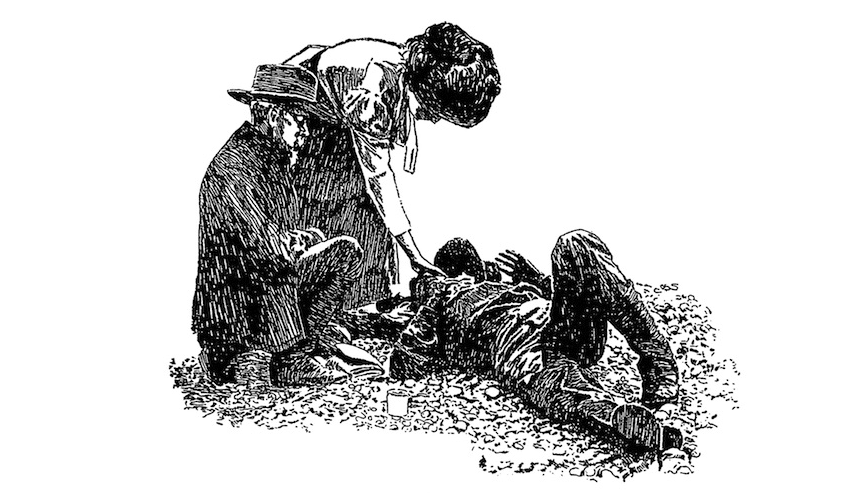
MILK FOR A PROSTRATE REGULAR
Surgeon Aby and Mrs. Mott found this soldier of the Third Infantry in the agony of death on the ground at Camp Wikoff.
— Haydon Jones, Illustrator. The World, August 27, 1898
———————————
‘Help For Montauk Troops’
Newport, R.I. — At daylight to-morrow the United States ship Vicksburg will leave here for Montauk Point … The vessel is literally packed with delicacies, vegetables, canned soups, fruit, fresh meats packed in ice, and tons of other stuff such as the heroes require to rebuild their broken-down health….
Early to-morrow morning Col. John Jacob Astor will go to Montauk Point on his yacht Nourmahal … with the choicest delicacies and needed food…The value of the supplies is over $3,000. Among the subscribers were Cornelius Vanderbilt and Colonel John Jacob Astor.
— New York Times, August 27, 1898 — BULLY pages 146 – 147
———————————

Pulitzer’s The World / Illustrator, Cory — August 28, 1898
———————————
‘An Appeal For Starving Men’
Every citizen of generous impulse and humane feeling should contribute something toward the relief of our soldiers, either in supplies or in money… The supplies most needed are plain soups, such as chicken, julienne, consomme, beef, mutton, &c., beef extracts, jellies, eggs in great quantity, oranges, lemons, grapes, wines, whiskey, brandy, and all sorts of food suitable for convalescents.
— New York Merchants’ Association / The Sun — BULLY pages 195 – 196
———————————
‘The Sloop Lillian’
Last night the sloop Lillian left New Suffolk for Montauk laden to the water line with fresh supplies, just such as are needed at the camp….The movement to send supplies was started in New Suffolk two days ago, and the success it met with enabled the Lillian to get away last night with as much goods on board as she could safely carry. The movement was led by Mrs. Stewart Moore and others of New Suffolk, and the generous people of Cutchogue gave valuable help…The cargo consisted of fresh eggs, fresh vegetables of every kind, canned meats, jellies, preserves, two hundred chickens and reading matter.
— Brooklyn Daily Eagle, September 1, 1898 — BULLY page 201.
———————————
‘The Steamer Kelple’
The steamer Kelple, chartered by Ella Wingate Ireland, who is a cousin of General Wheeler, arrived in Montauk yesterday…loaded down with delicacies for the soldiers at Camp Wikoff, beside having on board some forty-five patriotic citizens of Greenport, Southold, East Marion and Orient, who desired to see the encampment and also assist in distributing the cakes, pies, soups, vegetables, fruits and other refreshing articles to the worn out heroes….Cases of wine, champagne, brandy and mineral water were among the other valuable offerings…. Contributors included Ella Wingate Ireland, Miss May Ireland, Miss Addie Ireland, Jack Ireland, Miss Ennever, Henry Geehreng, the Rev. Mr. & Mrs. White, the Rev. and Mrs. Loren A. Rowley, Mrs. Edwards, Mrs. H. Tuthill, Mrs. Harry Tuthill, Captain Ackerly, A. Corwin, Master Corwin, J.T. Gallup, Miss Florence Reeve, Miss Allie Clark, D.L. Clark, Ralph Ford, L.T. Wells, Miss Florence House, Mr. & Mrs. J.T. Tuthill, D.T. Conklin, S.P. Hedges, Palmer Welden, Frank Hedges, A.W. Tuthill, Mr. & Mrs. C.J. Burns, Mr. Bahr, Mr. Oscar Fordham, Mrs. Swain, Mrs. Cone, Miss Minnie D. Hallock, Miss Minerva C. Ballard, John Delaney, Mr. & Mrs. Charles L. Youngs, Miss Grace Youngs, Miss Grace House, Miss Estelle House, Captain Austin Bennett, Alexander Monsell.
— Brooklyn Daily Eagle, September 2, 1898 / BULLY pages 217 – 218.
———————————
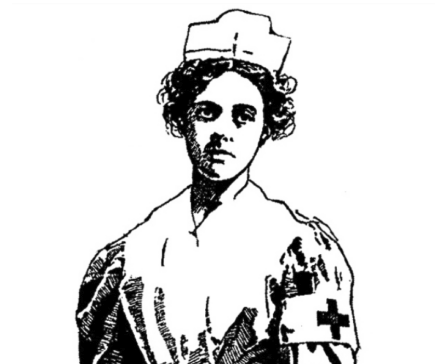
‘Succumbed to Exhaustion’
Miss Cherrie M. French, the young woman who succumbed to exhaustion at Camp Wikoff last Wednesday and was brought that night to Bellevue Hospital, has returned to the stricken camp… Miss French’s home is at Waterbury, Connecticut, and she stepped from a life of comfort and pleasant social surroundings to the camp of dying soldiers, giving her services without charge.
— Pulitzer’s The World, September 3, 1898 / BULLY page 221.
———————————
Steamer John Lenox
The Steamer John Lenox, which left New York last night, arrived this morning laden with provisions for the sick in the regimental camps. The steamer brings about $ 8,000 worth of delicacies…collected under the auspices of the Merchants’ Association. The steamer also brings 700 cots, undershirts and other wearing apparel.
———
Contributions from Hempstead
Among the many contributions received at the Eagle Tent [Newspaper Row] are three large cases of substantials and delicacies sent by the women of Hempstead…They contained canned and preserved foods, from soups to jellies, a quantity of smoked meats and similar relishes, beside many useful articles ….
———
Supplies come from Connecticut
Captain Alexander P. Loper’s yacht, Vida. As usual in Old Stonington, the supplies more than equaled the carrying capacity of the yacht. The yacht arrived yesterday and delivered several wagon loads of supplies.
— Brooklyn Daily Eagle, September 3, 1898 / BULLY page 222
———————————

Pulitzer’s The World / Illustrator, Heyer — September 4, 1898
———————————
Nurse Maude Edwards
Amagansett — Miss Maude Edwards, of Nyack, New York, employed as a nurse at Ocean House [auxiliary hospital], was taken sick four days ago and died at 3 AM this morning. Drs. Bell and Lewis, of East Hampton, were in almost constant attendance, but failed to save the woman’s life. They pronounced it typhoid fever in its worst form.
— Pulitzer’s The World, September 7, 1898 / BULLY page 502.
———————————
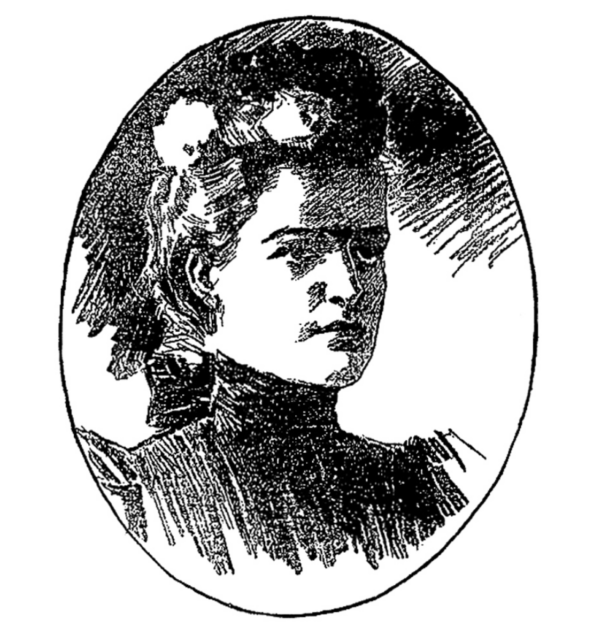
‘Praise for Miss Gould’
Helen Gould has made herself loved by hundreds of men whom she will never know by her good work. Not content giving thousands and tens of thousands, she has come several times to inquire into the condition of the men. Her sweet face and eyes fairly glowed with sympathy and compassion as she looked upon the suffering soldiers in the hospitals.
Then she went home and gave more thousands to carry on the work.
One of the sick soldiers asked, “Who is that little woman in black?” When told it was Miss Helen Gould, he said, “And did she come here just to see us and to help us? She must be a good woman. God bless her.”
— Harvey L. Reese, New York Press, September 5, 1898 / BULLY, page 266 | Illustration, Hearst’s New York Journal
====================================================
BREAKING NEWS
WHEELER’S SON LOST
Ditch Plains, Montauk — The Sun, September 7, 1898 / BULLY, pages 289 – 292
———————————
WHEELER’S BODY FOUND
… It is believed that Lieut. Newton D. Kirkpatrick, who was weak from the effects of fever in Cuba, was overpowered by the sea and that young Wheeler [Naval Cadet Thomas Wheeler, serving as an aide-de-camp to his father] went to his aid. From the marks on Wheeler’s body, it would seem that he got the drowning Lieutenant on his back and was bearing him to shore when he was overcome himself.
— New York Times, September 9, 1898 / BULLY, pages 297 – 298
———————————
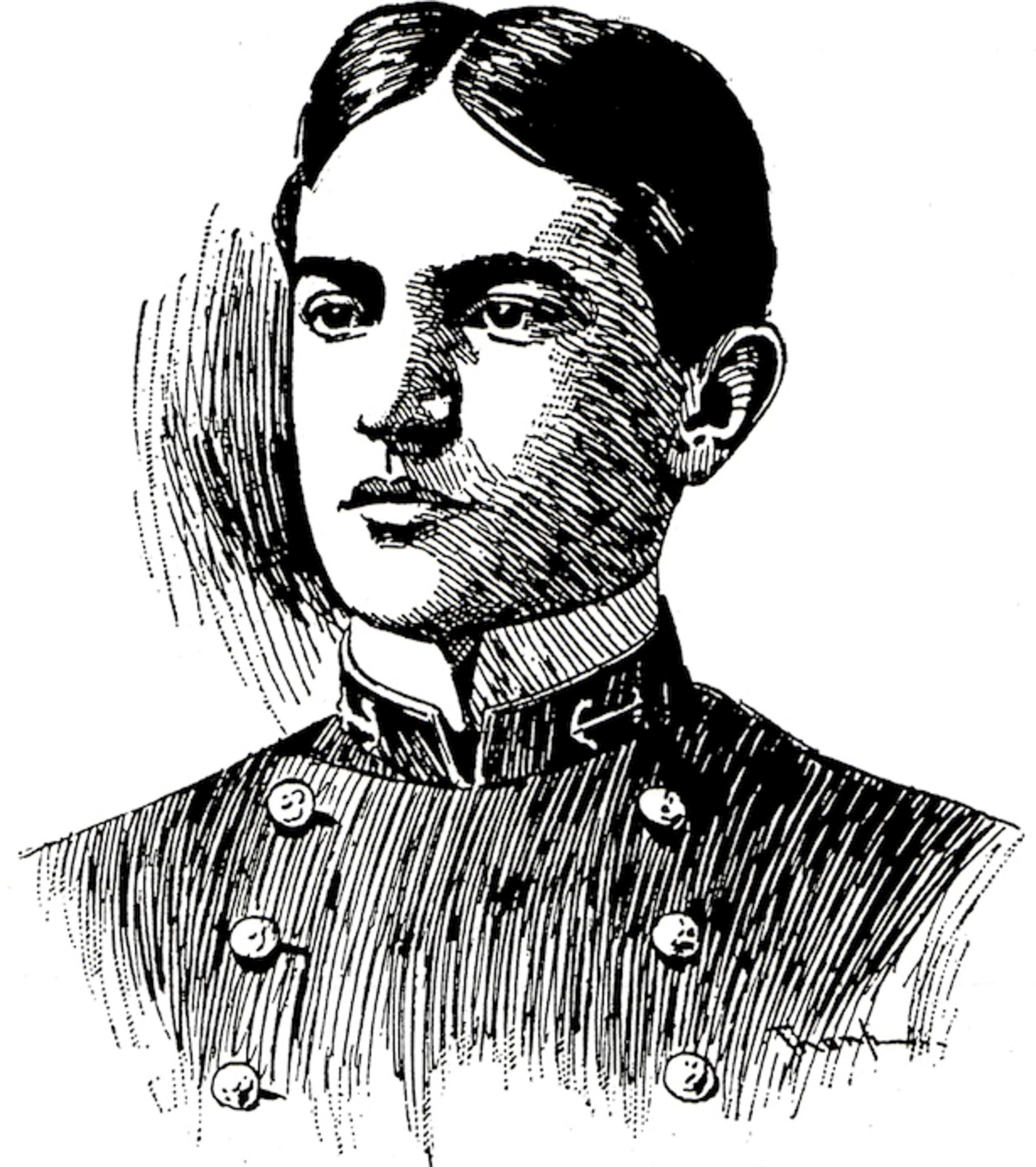
Naval Cadet Thomas A. Wheeler
HEROES IN TEARS WITH WHEELER
A quartet of singers from the tents of the Y.M.C.A came and as two artillery caissons drawn by six black horses rolled up and stopped … the singers sang, ‘Nearer My God to Thee’. General Wheeler, his two daughters and his one remaining son, Lieut. Joe Wheeler, Jr., took their places beside the two caskets and remained there standing throughout the ceremony.
— Hearst’s New York Journal, September 10, 1898 / BULLY, pages 307 – 308
====================================================
The Noble Work of Women
….On Wednesday, Mrs. Armitage and her daughter, Miss Patty, Mrs. Rudish, Miss Turnbull and Rufus K. Corneille visited the camp and brought away with them seventeen Rough Riders, eleven of whom were conveyed to Oakdale, where they were taken into the home of W. Bayard Cutting, Jr….
———
Colonel Roosevelt Pleased With Their Efforts
Colonel Roosevelt is greatly pleased with their efforts and told them they were doing the greatest and best work when they took men away from the camp, who were ill. His men idolize him, and everywhere the party goes, they hear praise of him and his kindness. His only thought now is to get his men away from camp in as good condition as possible. Altogether they have brought forty soldiers from the camp, all of whom were Rough Riders, save one who is of the Thirty-third Michigan Volunteers. All were placed in homes of families in Bay Shore and Islip, where they are receiving the most considerate attention. [Harry B. Hollins residence in Islip…the Dominy House at Bay Shore…the residence of Mrs. Mowbray at Bay Shore…At the Cutting place at Oakdale a large number of soldiers from Camp Wikoff are being cared for, and the hospital which was established by some of the summer residents at East Islip is also full….]
— Brooklyn Daily Eagle, September 9, 1898 / BULLY pages 300 – 301.
———————————

One Brave Girl
….The demonstration of American women’s patriotism and unselfish devotion has helped to make glorious the war with Spain….the women who have everywhere cared for the sick and wounded soldiers, are as worthy of their country’s honor as the soldiers themselves…. One of these nurses is Miss Eleanor L. Coe, a charming woman, but twenty-three years old, who is a volunteer nurse at Camp Wikoff….Impelled by her womanly desire to minister to the suffering, Miss Coe had studied how to render first aid to the injured, so her services so freely offered were gladly accepted at Camp Wikoff.
— The World, September 9, 1898 / BULLY page 300 | Illustration, The World.
———————————
‘First Batch of Convalescents in East Hampton’
— at Building owned by David Fithian
The new hospital equipped under the direction of the East Hampton Relief Corps, received thirty patients from Camp Wikoff last evening.The building is a two story structure … owned by David Fithian … The arrangements for this recuperative hospital have been made under the direction of Mrs. L.G. Woodhouse, Mrs. T.L. Manson, Miss Julia A. Chadwick … whose efforts have already resulted in saving the lives of many of the men at death’s door, through the lack of attention, apparently inevitable, in a great camp filled with fever-stricken men.
— at House owned by Clarence Hand
Arrangements to care for twenty-five invalids. They will be under the care of Dr. George E. Munroe, Vice President of the Maidstone Club [and] $ 3,200 has been collected by the East Hampton Relief Corps for the aid of the soldiers at Camp Wikoff.
— Brooklyn Daily Eagle | The Corrector (Sag Harbor), September 9 1898 / BULLY! pages 302 – 303.
———————————
The Sag Harbor Soldiers’ Rest
There are now twenty-two men in the Soldiers’ Rest of the original thirty-two and about half of these are still so sick as to be confined to their beds. An effort is now being made to get furloughs for these men , so that they need not be compelled to return to camp immediately, but go to their homes direct from this place….
— Brooklyn Daily Eagle, September 17, 1898 / BULLY page 354.
———————————
Samuel Parrish of Southampton
On the 16th of September the regiments were going away at the rate of two a day and there were only ten thousand men in the camp. The Detention Hospital was practically closed and the number of patients in the General Hospital reduced to six hundred. Our principle work was to superintend the daily departure of the various regular regiments who had their sick with them. Mr. Samuel Parrish of Southampton took charge of this work. He began to work for the Red Cross early in September and gave his entire time to visiting the men in sick quarters in their tents in the various regiments.
— Red Cross Agent Howard Townsend’s Report, page 537.
———————————
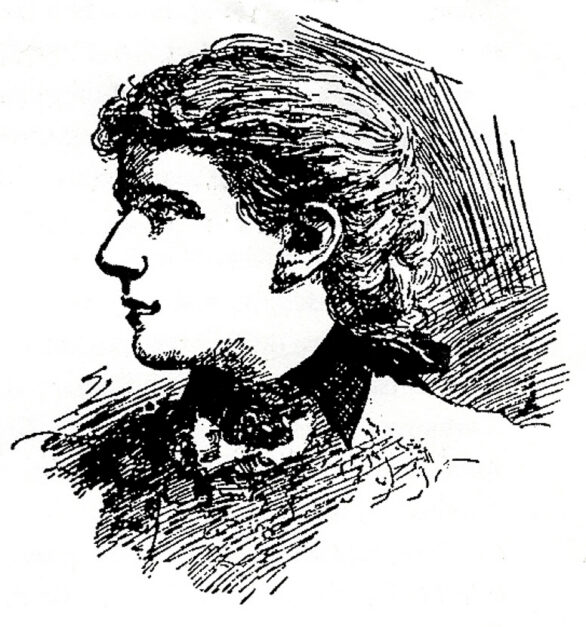
Reubina Hyde Walworth, Heroic Nurse
Great masses of roses and lilies surround the bier of Reubina Hyde Walworth,
a heroic nurse, who gave her life for the suffering at Camp Wikoff….
——————
It was when Camp Wikoff became a vast. pest hole that Miss Walworth’s devoted sacrifice shone brightest. For a time she helped her mother in the General Hospital and there rendered invaluable service. But the sight of the Detention Hospital, which she passed every day, with scores of fever-stricken, gaunt and war-worn men, wrung her gentle heart.
No woman was there. Miss Walworth could not endure the thought that the patients were suffering
for want of a woman’s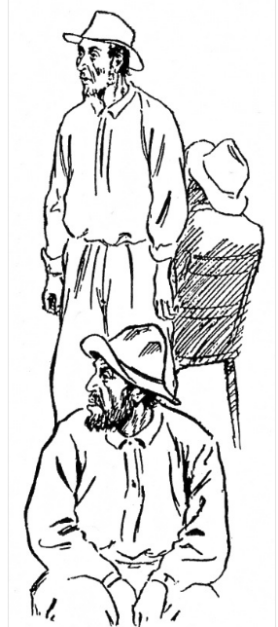 gentle hand.
One day she told her mother that she had resolved to volunteer for service in the isolation tents. Her mother tried her utmost to dissuade her from the sacrifice, but at length allowed her to carry out her generous purpose
She entered upon the performance of her duties and was there many weeks, the only woman among those awful spectres of famine and fever. Day and night she passed between the lines of suffering soldiers , smoothing pillows of the delirious, administering medicines, receiving the last messages of the dying and the blessings of those of whose sufferings she lessened with her gentle care. Miss Walworth’s isolation was complete. Her mother could only drive past and wave a greeting to her daughter, since the rules would not permit her to enter the Detention camp.
Miss Walworth refused to leave her post until the last patient had gone his way. Then she told her mother that she, too, was ill. Miss Walworth’s illness developed into typhoid fever in its malignant form. Not one dreadful pang of that fearful scourge was spared her, and her suffering was very great. The courage that had sustained her while ministering to the sufferings of others did not desert her as she lay dying, and she was cheerful to the end.
Her mother was with her when she died and took her daughter’s body to her home.
— Pulitzer’s The World, October 19, 1898 / BULLY pages 446 / 447. Patients illustration, New York Press / BULLY page 279.
———————————

BRAVEST OF THE BRAVE
— ‘Where They Lie Buried at Camp Wikoff’ / page 309 — Haydon Jones, Illustrator. The World, September 9, 1898
———————————
Roster of Deaths at Camp Wikoff / BULLY pages 499 – 508, Second Edition
====================================================================

Chicago Tribune Masthead, 1898.
=========================================================================

National Military Park Proposal
Newsletter # 5
June 14, 2026
The intent of this newsletter is to inform the general public about Camp Wikoff, the great military encampment established in Montauk, New York, 1898, for the rest & recuperation of Gen. William Shafter’s Fifth Army Corps in preparation for the fall campaign against Havana, Cuba, in the Spanish-American War.
The objective of this effort is to establish Camp Wikoff National Military Park as an enduring tribute to the civilian & military volunteers of 1898.
As America’s tenth national military park, Camp Wikoff would mark the historic transition from mainland wars to wars fought overseas on foreign soil.
————
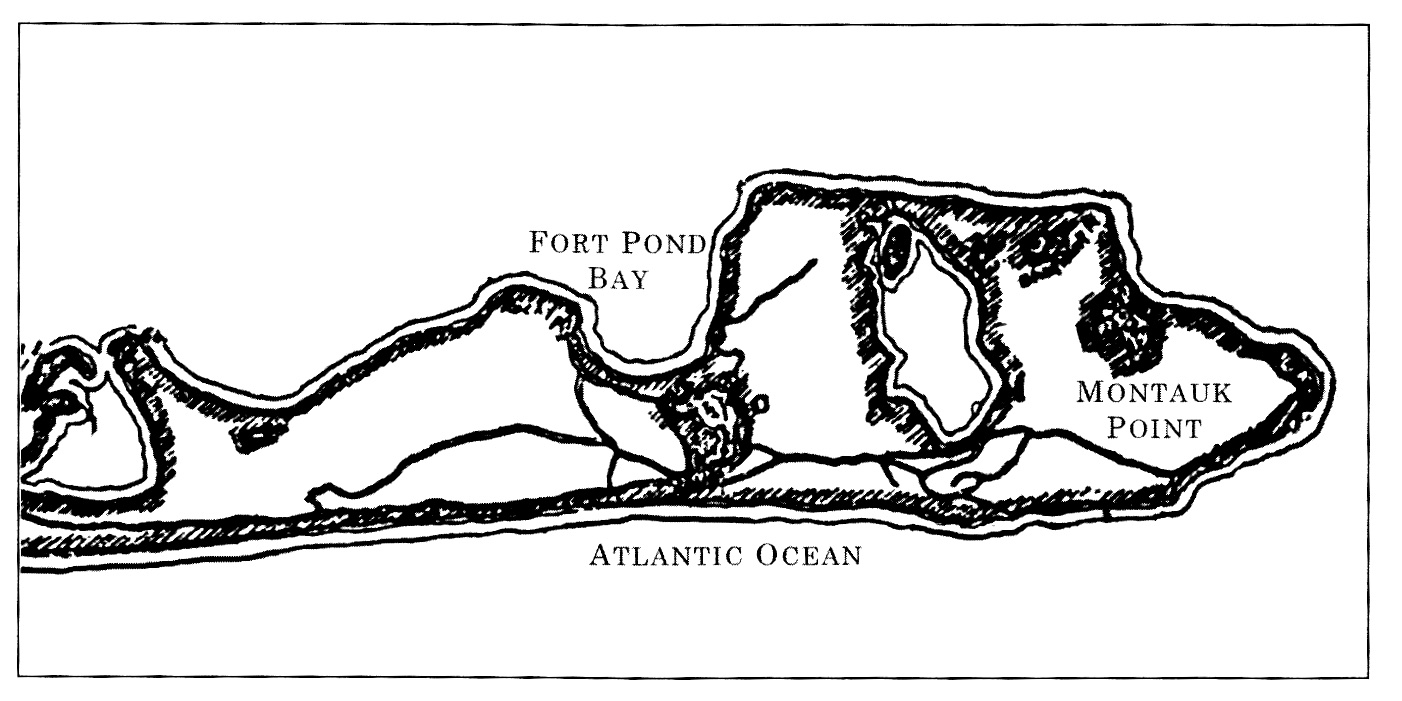
Fort Pond Bay is the main component of the proposed Camp Wikoff National Military Park.
As the Homeport of America’s first veterans of a war fought overseas,
Fort Pond Bay represents all homeports and points of return of America’s veterans of foreign wars.
————
Comments & suggestions welcome.
Jeff Heatley, Editor
With appreciation for Brian Tadler’s review & advice.
Note: to receive Newsletter updates, please send request to info@aaqeastend.com
~~~~~~~~~~~~~~~~~~~~~~~~~~~~
Thank you to the following organizations for their letters of support:
————
Buckey O’Neill Camp No. 175 – AZ / Sons of Spanish-American War Veterans
————
Lester F. Quinn Memorial Association
————
Sons of Spanish-American War Veterans / National Organization
————
Note: This proposal, in modified form, received the support of Brigadier General Patrick Finnegan,
Dean of the United States Military Academy at West Point / March 4th, 2008.
——————————————
EVENTS 2026


OPENED JULY 4TH, 2026 …. click bar.
———————
UPCOMING …..
THIRD HOUSE / SUFFOLK250 / September 19th w/ Re-enactors: Roosevelt, Wheeler, Pershing — Celebrating 250th, as well as 125th Anniversary of Roosevelt becoming President (9.14.1901), Parade — from Montauk Station to Third House w/ carriages, horses & wagons — and historic mustering out of the Rough Riders (9.15.1898).
| ~~~~~~~~~~~~~~~~~~~~~~~~~~ |
|

|

=========================================================================
CAMP WIKOFF NATIONAL MILITARY PARK Proposal
HOMECOMING
Tribute to Military & Civilian Volunteers / Montauk, 1898
OVERLAY PARK CONCEPT
Overlay Park consists of land that was part of Camp Wikoff that is now Town, County, State parkland.
Overlay would add signage, monuments, dedicated benches and markers to those sites.
~~~~~~~~~~~~~~~~~~~~~~
CW NATIONAL MILITARY PARK OVERLAY COMPONENTS
————
Fort Pond Bay & Beach: Re-construction of the Pier /Monument to the U.S. Fifth Army Corps
Fort Pond Bay to Montauk Station: Construction of Camp Wikoff Memorial Walkway w/ Information Kiosk
Montauk Village Green: Monument to President William McKinley
Shadmoor State Park — Monument to Lieut. Black Jack Pershing & 10th Cavalry, aka Buffalo Soldiers
Ditch Plains — Monument to General Joseph Wheeler and his daughter, Laurie, a Camp Angel
Third House — Re-construction of the barn that stood near Third House in 1898 for Roosevelt’s Rough Riders Museum
Montauk Point State Park — Monument to the 60+ soldiers buried at sea.
Montauk Downs Golf Course / Location of the General Hospital — Monument to the American Red Cross / Sisters of Charity
Fort Hill Cemetery / Location of the Detention Hospital — Monument to the soldiers who died at Camp Wikoff
~~~~~~~~~~~~~~~~~~~~~~
CW NATIONAL MILITARY PARK ANNUAL EVENTS
MONTH OF APRIL: Navy Vessel anchors in Fort Pond Bay, Offering Tours
LAST WEEKEND IN APRIL: Lectures on Camp Wikoff | Half-Marathon | Ocean Beach Walk | Hike at Shadmoor State Park
MONTH OF MAY: Lectures on the Spanish-American War at Historical Societies, Libraries & Schools at Points West of Montauk
THIRD WEEKEND IN OCTOBER @ THIRD HOUSE: Re-Enactors & Demonstrations | Bike Tours of Historic Camp Wikoff | Hike to Montauk Light | Platform Tent Camping
MAIN EVENT — THIRD SUNDAY IN NOVEMBER / BEACH AT FORT POND BAY: HOMECOMING TRIBUTE TO MILITARY & CIVILIAN VOLUNTEERS | Speech on Historic Significance of Camp Wikoff | Reading of Names of those who died at Camp Wikoff | Soloist Sings ‘Home! Sweet Home!’
————————
YEAR ROUND:
—- Self-Guided Bike / Hike / Run w/ Ocean Swim & Horseback Riding Options — Tour
—- Officers Tent / Platform Camping at Third House site / Seasonal — With select Veterans only weekends.
=================================

Amazon BULLY …. link
————————————————–
REMEMBER

Visit AAQ Portfolios
The Case for Camp Wikoff National Military Park, 1898 …. link
Camp Wikoff NMP Proposal: Newsletter # 4, June 15, 2026 …. link
_____________________________________________