
Proposal to Establish
HOMECOMING
AMERICA’S TENTH NMP
Camp Wikoff National Military Park
TRIBUTE
Military & Civilian Volunteers / 1898
~~~~~~~~~~~~~~~~~~~~
Newsletter # 7 / September 14, 2026
Opened August 8th — Closed October 9th, 1898
~~~~~~~~~~~~~~~~~~~~
STATE OF THE UNION, 1898
~~~~~~~~~~~~~~~~~~~~
Montauk Point’s ‘BULLY PULPIT’
Sunday, September 4, 1898 …. News had gone around that Teddy, the idolized Colonel, was going to preach the sermon of the day — and it was a very remarkable sermon….
Roosevelt was the same old Roosevelt….He made the same old grimaces when he spoke and showed his teeth just as conspicuously as before and when he told of a man who said things that were not catalogued in the prayer books, he repeated those things, with emphasis, too.
“Our trials, our hardships, our victories, we have all shared together, officers and men. There has been no distinction, we have all worked for and accomplished the glory of the regiment…. Carry that same sentiment and spirit into your life when you separate for your homes. Every man has felt that the honor of the regiment was in his keeping, and he would reflect honor or dishonor on all by his individual acts….
“The world will be kind to you for about ten days. Everything you do will be right. After that you will be judged by a stricter code, and if you prove worthless, you will be considered as spoiled by going to war. Uncomplaining obedience, an acceptance of whatever came, is one of the things that has made me admire, respect and love you all….
“In closing, I only want to say that I feel a love and attachment to each and every one of you and that we are bound together by ties that death alone can sever.”
— Brooklyn Daily Eagle, The Sun, New York Herald and The World / BULLY! pp 262-265
~~~~~~~~~~~~~~~~~~~~~~~~~~~~~~~~~
ROOSEVELT WILL RUN
Saturday, September 10, 1898 …. Now that the war is over and his regiment will be mustered out in a few days, Colonel Roosevelt has authorized the following statement:
That he has always been a Republican in the broadest sense of the word; that he has not been seeking the Republican nomination for Governor, but should it come to him, he would gladly accept it as an honor and a duty, recognizing, as he does, the dignity and honor of the position….”
— Brooklyn Daily Eagle / BULLY, pp 314 – 315
~~~~~~~~~~~~~~~~~~~~~~~~~~~~~~~~~
CAMP WIKOFF
Monday, September 12, 1898 .…One member of the army who will sincerely regret leaving Camp Wikoff when it is given up is Col. Theodore Roosevelt. The life here is the kind that exactly suits him. He would be worth money as the “after using” illustration of any tonic, so full of life and vigor does he appear….Much of his time is in the open air, and, whatever happens, he will not miss his afternoon’s wild gallop across the meadows and plunge into the sea. If he has men visitors they may come too, and if they don’t care to come they may wait in his tent, but his tussle with the surf he must have….
The writer will preserve for long one brief impression of Col. Roosevelt as he stood at the entrance of the mess tent with his head up, his chest expanded, and his powerful arms outstretched, breathing deep of the fresh sea air.
“Oh,” he said with a long sigh of prophetic regret, “I’ll miss this place when it’s all over!” Then he jumped on his horse and was soon a speck, rising and falling on a distant and darkening hillside.
— The Sun / BULLY! pp 317 – 318
~~~~~~~~~~~~~~~~~~~~~~~~~~~~~~~~~
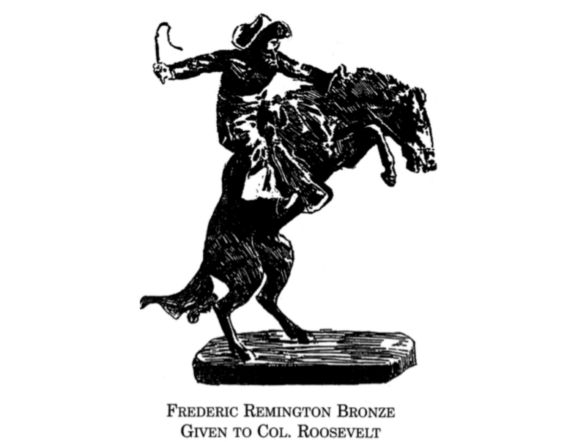 Roosevelt’s Farewell to His Men
Sunday, September 15, 1898 …. Private Murphy said, “While you held your officers in the highest esteem, on account of their gallantry, bravery and ability, your heart of hearts was ever with your men, whether in tented fields or in the trenches before the enemy’s lines …. One and all, from the highest to the lowest, hailing from this great and united country, will carry back to our homes a pleasant remembrance of your every act, for they have always been of the kindest as Colonel of the Rough Riders, and we hope that the bronco buster will continue through life to remind you of that fact.”
Col Roosevelt said: “Officers and men, I do not really know what to say to you. Nothing could possibly happen that would touch and please me as this has touched and pleased me. Trooper Murphy said quite rightly that my men were nearest my heart, for while I know I need not say to my officers in what a deep regard I hold them, they will not mind me saying that just a little bit closer come the men. …I am proud of this regiment beyond measure. I am proud of it because it is a typical American regiment. The foundation on the regiment was the cowpuncher, and we have got him here in bronze….
“The men of the West and Southwest, horsemen, riflemen and herders of cattle, have been the backbone of this regiment…Besides the cowpuncher, this regiment contained men from every section of the country, every State in the union, and because of that we feel proud of it….It gives me extreme pleasure to look around among you and see men of every occupation, men of means and men who work with their hands for a livelihood, and at the same time know that I have you for friends. You are men of widely different pursuits, yet you stand here side-by-side, you fought shoulder-to-shoulder….That is the American spirit. You cannot imagine how proud I am of your friendship and regard….
“Now I want to say just a word more to some of the men I see standing around not of your number. I refer to the regiments, cavalry regiments, who occupied our right and left flanks at Las Guasimas, the Ninth and Tenth cavalry regiments (Buffalo soldiers)….I am sure that I speak the sentiments of men and officials in the assemblage when I say that between you and the other cavalry regiments there is a tie which we trust will never be broken. (Cheers.) ….
“To have such a gift from this peculiarly American regiment touches me more than I can say. This is something that I shall hand down to my children and I shall value it even more than the weapons I carried through the campaign.”
As the Colonel finished some one suggested “Three Cheers for Colonel Roosevelt,” which were given in true cowboy style with an extra “tiger.” Then Capt. Curry of H troop shouted: “Three cheers for the next Governor of New York!” and the response was even more hearty….
— The Sun / BULLY! pp 323 – 326
~~~~~~~~~~~~~~~~~~~~~~~~~~~~~~~~~
Colonel Roosevelt Mustered Out
Wednesday, September 14, 1898 …. Col. Roosevelt marched up to Major Fishback’s tent at 5 o’clock last night and asked for his pay for one and a half months…
He watched the money being counted out with a smile, and then, having received the crisp bunch of bills, he wrote his name on the pay roll and without a word walked along Officers’ Row to the tent of the Inspector-Gen. Mills, the muster office. He answered the questions as to his name, rank and length of service and then listened to the reading of his discharge.
As Col. Roosevelt received the papers, he remarked to Lieut. Col. Brodie who stood beside him:
“This ends it, eh?” His manner and tone betrayed considerable emotion….
Col. Roosevelt spent the night in his tent…Next morning, Col. Roosevelt went to the railroad station in one of the camp stages, taking with him Lieuts. John C Greenway, John A. McIlhenny, Charles Ballard and Hal Sayre, Jr., who will be his guests at Oyster Bay for several days. Lieuts. David Goodrich and R.H. Ferguson will join the party to-morrow. Col Rooevelt still wore his campaign uniform, and as soon as the reached the station he was recognized. A party of Rough Riders was there ahead of him, having missed the train last evening. They all greeted their leader and shook hands again. The train left at 9 o’clock…At the station , Colonel Roosevelt spoke to an Eagle reporter. He Said:
“I am going direct to Oyster Bay and not to New York City. I will enjoy the visits of my officers who go with me to Oyster Bay and will remain several days. I would rather be a Rough Rider than a civilian, but I would rather fight than be idle in camp…. As for politics I have nothing to say.”
— Brooklyn Daily Eagle / BULLY! pp 341 – 342
~~~~~~~~~~~~~~~~~~~~~~~~~~~~~~~~~
Governor Black Hurls Bombshell: Roosevelt Not Eligible for Governor? — Sept 24, 1898 — NY Herald, pp 395 – 396
——————–
Black Will Be The Nominee — Sept 24, 1898 — New York Press, pp 397 – 398
——————–
Roosevelt Held Ineligible — Sept 25, 1898 — New York Press, pp 400 – 401
——————–
Talk Is Rubbish, Roosevelt Says — Sept 25 — Chicago Tribune, page 401
——————–
Colonel Roosevelt Bitterly Assailed — Sept 26 — New York Herald, page 402
——————–
It is a Democratic Year — Sept 26 — William Randolph Hearst’s New York Evening Journal, page 405
——————–
What Does It Mean? — Sept 27 — Commercial Advertiser, pp 407 – 408
——————–
An Illustrious New York Name — Sept 27 — The Sun, pp 408 – 410
——————–
Not Really A New Yorker — Sept 27 — William Randolph Hearst’s New York Evening Journal, p 410
——————–
HOW ROOSEVELT SWEPT THE FIELD — Sept 28 — New York Herald, Commercial Advertiser, pp 411 – 419
——————–
Our Standard Bearer — Charles E. Shepherd, Editor — Sept 28 — Long Islander, p 419
——————–
Notification Ceremonies At Oyster Bay — Oct 5 — New York Times, pp 425 – 426
——————–
Roosevelt Fires First Campaign Gun / Carnegie Hall — Oct 5 — New York Times, The Sun, The World, Commercial Advertiser, New York Press, pp 427 — 441
——————–
ROOSEVELT VICTORIOUS
Nov 9 — New York Tribune, BULLY! p 451
——————–
GOVERNOR ROOSEVELT — Nov 9 — New York Tribune, BULLY! p 453
~~~~~~~~~~~~~~~~~~~~~~~~~~~~~~~~~

Asst. Sec. of the Navy > War Hero > Governor, 1898
( Illustration, left: The Traveler, Nov 11 / Illustration, right: Boston Globe, Nov 9)
~~~~~~~~~~~~~~~~~~~~~~~~~~~~~~~~~~~~~
Chicago Tribune Masthead, 1898.
====================================================

National Military Park Proposal
Newsletter # 7
September 14, 2026
The intent of this newsletter is to inform the general public about Camp Wikoff, the great military encampment established in Montauk, New York, 1898, for the rest & recuperation of Gen. William Shafter’s Fifth Army Corps in preparation for the fall campaign against Havana, Cuba, in the Spanish-American War.
The objective of this effort is to establish Camp Wikoff National Military Park as an enduring tribute to the civilian & military volunteers of 1898.
As America’s tenth national military park, Camp Wikoff would mark the historic transition from mainland wars to wars fought overseas on foreign soil.
————
Fort Pond Bay is the main component of the proposed Camp Wikoff National Military Park.
As the Homeport of America’s first veterans of a war fought overseas,
Fort Pond Bay represents all homeports and points of return of America’s veterans of foreign wars.
————
Comments & suggestions welcome.
Jeff Heatley, Editor
With appreciation for Brian Tadler’s review & advice.
Note: to receive Newsletter updates, please send request to info@aaqeastend.com
~~~~~~~~~~~~~~~~~~~~~~~~~~~~
Thank you to the following organizations for their letters of support:
————
Buckey O’Neill Camp No. 175 – AZ / Sons of Spanish-American War Veterans
————
Lester F. Quinn Memorial Association
————
Sons of Spanish-American War Veterans / National Organization
~~~~~~~~~~~~~~~~~~~~~~~~~~~~~~~~~~~~~~~~~~~~~
Note: This proposal, in modified form, received the support of Brigadier General Patrick Finnegan, Dean of the United States Military Academy at West Point / March 4th, 2008:
Camp Wikoff played an important role in the American war with Spain in 1898. In many ways the Camp reflected the spirit of the times, especially with regard to volunteerism and the Progressive impulse of the late – 19th and early 20th centuries. Through its gates passed thousands of heroic Americans — military and civilian, famous and ordinary — whose commitment and sacrifice brought victory in the war. For these reasons and the many others you outlined in the proposal, we support your cause and encourage you to continue pursuing the project.
Best wishes for success in establishing Camp Wikoff as a national military park.
Patrick Finnegan
Brigadier General, US Army
Dean of the Academic Board
United States Military Academy / West Point
Note that Gen. Joseph Wheeler, Rough Rider Lieut-Col. Brodie, Lieut. John Joseph Pershing, who was also an Instructor, were West Point graduates, among others who served in the Spanish American War.
HISTORIC EVENTS & NOTABLE FACTS / CAMP WIKOFF
Gen. William Shafter’s Fifth Army Corps — America’s First Veterans of a Foreign War Fought Overseas returned Home at Fort Pond Bay, Montauk, August & September, 1898
————————————-
Overlay NMP Park Proposal
Given the development of Montauk as a resort community since 1898, an overlay park is proposed. Town, County & State Parks whose land was part of the 4,000-acre Camp, would add Monuments, Signage, Markers & Dedicated Benches. Proposal also includes a Camp Wikoff Memorial Walkway between Montauk Station and Fort Pond Bay (Long Island Railroad right of way). In addition, reconstruction of the Iron Pier on Fort Pond Bay also proposed, but not critical to the overall proposal.
Note that Fort Pond Bay is the main component of this proposal and that events have been scheduled off season, with Railroad transportation to and from Montauk Station advised.
————————————-
Annual Events
MONTH OF APRIL: Navy Vessel anchors in Fort Pond Bay, offering tours.
————
LAST WEEKEND IN APRIL
— Camp Wikoff Lectures
— Vernal Half-Marathon, Fort Pond Bay to Montauk Point to Fort Pond Bay,
with Montauk Seafood Chowder served on the Beach at Fort Pond Bay to those who finish.
— Ocean Beach Walk
————
MONTH OF MAY
Month of May: Spanish-American War Lectures at Colleges, Universities & Historic Societies & Libraries
————
THIRD WEEKEND IN OCTOBER
Re-Enactments of President McKinley’s Address to the Troops, Col. Roosevelt’s Bully Pulpit & Farewell Addresses
Re-Enactors: Pres. McKinley, Col. Roosevelt, Gen. Joseph Wheeler, Lieut. Black Jack Pershing, American Red Cross Nurse Laurie Wheeler, Nurse Ellen Walworth of the Women’s National War Relief Association, Philanthropist Helen Gould, American Red Cross Agent Howard Townsend, Signal Corpsman Ambrose Higgins
Exhibit of Newspaper Illustrations & Archival Photographs
Demonstrations: Wigwagging, Telegraphy
Platform Wall-Tent Camping w/ Bonfire
Wagon Rides & Hikes to Montauk Point Lighthouse
Guided Bike & Hike Tour of Historic Camp Wikoff
Horseshoes Tournament
Autumnal Half-Marathon from Fort Pond Bay to Montauk Point & back,
with Roosevelt Beef Stew served on the Beach at Fort Pond Bay to those who finish the race.
Seasonal
Platform Tent Camping at Third House, with select Veterans Only Weekend
Self-Guided Bike, Hike, Ocean Swim, Horseback Riding Tours of Historic Camp Wikoff
————
THIRD SUNDAY IN NOVEMBER
HOMECOMING TRIBUTE
————
MILITARY & CIVILIAN VOLUNTEERS
Beach at Fort Pond Bay
Address: Lessons of Camp Wikoff
Reading of the 340+ names of those who died at Camp Wikoff, and of the 60+ names of those who died on board the transports from Santiago de Cuba and were buried at sea.
Recognition of the Organizations that provided supplies to the troops at Camp Wikoff, including the American Red Cross, Sisters of Charity, Women’s National War Relief Association, East Hampton Relief Corps, NYC Merchants Association, among others.
Soloist Sings: John Howard Payne’s HOME! SWEET HOME!
The most popular song on board the transports returning HOME.
Roosevelt Beef Stew Served.
—————————–
Proposed Monuments / Markers
Monument to President William McKinley, Village Green
Monument to Gen. Joseph Wheeler & Daughter Red Cross Nurse Laurie Wheeler, Ditch Plains
Monument to Buffalo Soldiers & Lieut. Black Jack Pershing, Shadmoor
Monument to American Red Cross / Sisters of Charity, Montauk Downs State Park
Monument to 340 Soldiers Who Died at Camp Wikoff, Fort Hill Cemetery
Monument to Col. Roosevelt & Rough Riders, Third House County Park
Monument to 60 Soldiers Who Died at Sea, Montauk Point State Park
=================================
Echoing thru NYC City Streets
EXTRA! EXTRA!
QUARANTINE IN MONTAUK
YELLOW FEVER! MALARIA! TYPHOID!
READ ALL ABOUT IT!
——————–

BULLY! a Newspaper Chronicle / 1898 | Second Edition, 2023,
Published by the Montauk Historical Society & East End Press,
with a Grant from the Gardiner Foundation.
Amazon BULLY …. link
————————————————–
REMEMBER
Visit AAQ Portfolios
Spanish-American War / Camp Wikoff, 1898 Timeline …. link
Camp Wikoff NMP Proposal: Newsletter # 6 / August 15, 2026 …. link
Camp Wikoff NMP Proposal: Newsletter # 5 / July 15, 2026 …. link
TR Presidential Library / News 8.28.25: TeddyCon | Talks, Exhibits | Badlands Gateway Trails …. link
~~~~~~~~~~~~~~~~~~~~~~~~~~~~~~~~
Additional CW Portfolios can be viewed on
Art & Architecture Quarterly / East End: www.aaqeastend.com

___________________________________________________________